
Reviewed · REMBRANDT & DUTCH MASTERS TOURS
Private Tour of Vermeer’s Delft + Tickets to Vermeer Museum
Delft becomes the subject of a Vermeer painting on this private walking tour. You follow the painter from his birthplace and family homes to his grave, then look across the water from the same angle used for View of Delft. I like the close link between art and place, and I like having a private guide who can stop for your questions instead of moving a whole group along.
The tour also brings in Delft’s larger story, from William of Orange to Antoni van Leeuwenhoek and Hugo Grotius. The main drawback is the price, $232.71 per person, and the walking portion can feel long if you want only a quick museum visit. Pickup can help with transport, but it must be selected as an option.
In This Review
- Key points to know before booking
- Why Vermeer makes Delft worth seeing on foot
- The Markt, where Vermeer’s life comes together
- Vermeer’s grave inside the Old Church
- Prinsenhof and the politics Vermeer inherited
- Water, trade, and the road to View of Delft
- Hooikade and the exact angle of View of Delft
- Maria van Jessekerk and Vermeer’s home
- Vlamingstraat and the Little Street
- One and a half hours at the Vermeer Centrum Delft
- Is $232.71 per person a fair price?
- Who should book this Delft experience?
- My booking advice
- FAQ
- Where does the Vermeer Delft tour start?
- Where does the tour end?
- How long does the experience take?
- Is the Vermeer Centrum Delft admission included?
- Is admission to the Old Church included?
- Is this a private tour?
- Is hotel pickup available?
- Can I cancel for a full refund?
- Are service animals allowed?
Key points to know before booking
- A private route through Vermeer’s real Delft: See where he was born, lived, worked, and was buried.
- The best art-history moment: Compare the view from Hooikade with Vermeer’s View of Delft.
- Two historic churches included: Enter the Old Church to see Vermeer’s grave, and visit the New Church near the Markt.
- A guide-led museum finish: Enter the Vermeer Centrum Delft with an audio guide after the walking tour.
- Robin is a named guide: The feedback specifically praises Robin’s clear English, patience, and command of Delft and Dutch history.
- Flexible transport choices: Meet at the Hugo Grotius statue on the Markt, or select hotel pickup and drop-off by car where offered.
Why Vermeer makes Delft worth seeing on foot
Johannes Vermeer painted only a small number of known works, but his Delft feels precise and lived-in. This tour helps you connect those quiet interiors and city scenes with actual streets, churches, canals, businesses, and civic buildings.
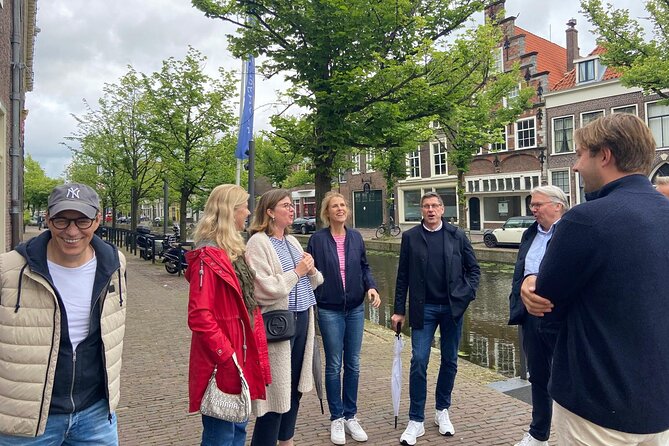
You begin at the Hugo Grotius statue on the Markt, right in the center of Delft. That is a useful starting point because the square gathers several threads of Vermeer’s life in one place. The New Church, the town hall, his father’s former house, the house he later owned, the butter house, the weighing house, and Delft’s oldest shop all sit within the opening section.
I like this start because you are not asked to admire Vermeer in isolation. You see the social and commercial setting around him. The guide can explain how a painter’s life was tied to family property, guild membership, local trade, and the religious divisions of the Dutch Republic.
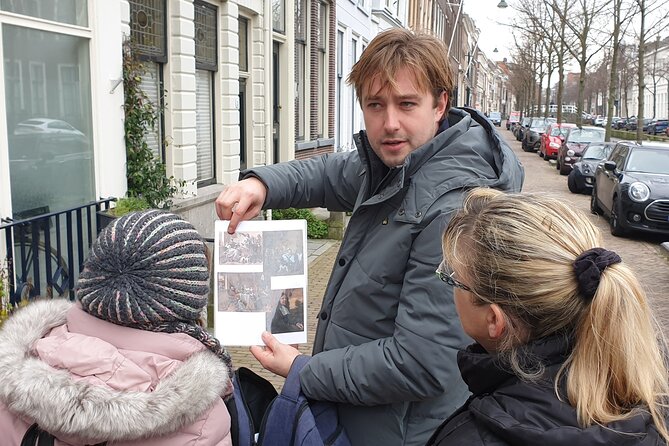
The private format matters here. You can ask why one building mattered to Vermeer, stop to examine a facade, or spend less time on a subject that does not interest you. The named guide Robin received especially strong praise for speaking clearly, answering questions patiently, and linking Vermeer with Dutch history.
More Entry Tickets in The Hague
- The Hague: Mauritshuis Entrance Ticket
★ 4.7 · 2,706 reviews - The Hague: Madurodam Miniature Park Entry Ticket
★ 4.6 · 1,559 reviews - The Hague: The Pier SkyView Ticket with Drink and Snack
★ 4.4 · 1,398 reviews
The Markt, where Vermeer’s life comes together
Allow about 20 minutes at the Markt, although the exact pace depends on your questions and the group. The square is not simply a scenic opening. It is the place where much of Vermeer’s personal world comes into focus.
You will hear about his father’s old house and the later house associated with Vermeer himself. You will also see the New Church and Delft’s historic civic buildings. The guide uses these places to explain the city that shaped Vermeer before you even reach a museum.
The New Church is included, although the itinerary gives more attention to the Old Church later in the walk. The Markt is also a practical meeting point. If you arrive by public transport, it is near public transportation, and the activity starts and ends in the city center unless you select pickup.
One small caution: a square with many landmarks can feel crowded with facts. If you already know Vermeer well, tell the guide what you want to explore most. The private setting gives you a better chance to shape the emphasis.
Vermeer’s grave inside the Old Church
From the Markt, you walk to the Old Church, known locally as the Oude Kerk. The visit lasts about 45 minutes and includes admission to the church and Vermeer’s grave.
This is one of the most meaningful parts of the route. Vermeer was not a distant figure who passed through Delft for a few years. He was born, worked, and died there, and the Old Church is where he was buried alongside other notable Dutch figures.
I find this stop valuable because it puts a human limit around the paintings. Vermeer’s work can seem private and almost weightless, but his life unfolded amid family responsibilities, financial pressure, religious divisions, and the daily business of a seventeenth-century city. Standing at his burial place gives the tour an important pause.
The church visit is not just a photo stop. You can take time to look at the building and listen to the guide’s explanation. Wear comfortable shoes, since the experience combines church standing time with several more walking sections afterward.
Prinsenhof and the politics Vermeer inherited

The route continues to Museum Prinsenhof Delft, where William of Orange, often called the Father of the Fatherland, was killed. The visit here takes around 15 minutes, and admission to the building is not included as a museum entry.
The point is context. This assassination happened nearly 50 years before Vermeer was born, but it shaped Delft’s place in Dutch history. The guide uses the stop to connect Vermeer’s peaceful-looking city scenes with the political and religious conflicts that defined the Netherlands around his lifetime.
You should not expect a full museum visit at Prinsenhof on this tour. Instead, you get the setting and the story as part of the walk. That is a sensible use of time for a Vermeer-focused route, though anyone wanting to explore Prinsenhof’s collections will need a separate visit.
The tour also introduces Hugo Grotius and Antoni van Leeuwenhoek. Grotius is linked with the development of international law, while Van Leeuwenhoek discovered microbes and knew Vermeer. These names help you see Delft as a place of law, science, trade, religion, and painting, not only as the home of blue-and-yellow ceramics.
More Museum Tours in The Hague
- The Hague: Escher in The Palace Museum Ticket
★ 4.6 · 896 reviews - Royal Delft: Delftblue Factory and Museum Admission Ticket
★ 4.5 · 145 reviews - The Hague: Panorama Mesdag Museum Entry Ticket
★ 4.8 · 143 reviews - The Hague: Prison Gate Museum
★ 4.5 · 58 reviews
Water, trade, and the road to View of Delft
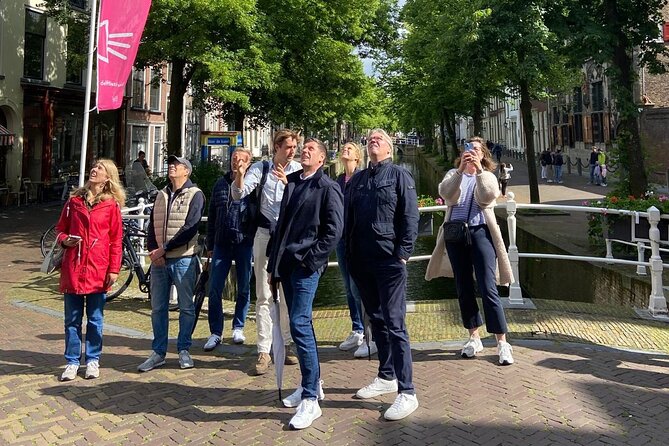
The walk heads south toward the angle associated with View of Delft. Along the way, you pass the Gemeenlandshuis van Delfland, an impressive water-board facade dating from around 1500.
This is a good reminder that Dutch cities depended on organized water management. The building is not included because it is directly tied to a famous Vermeer canvas. It helps explain the civic systems that allowed Delft to function.
Next comes the VOC-Kamer Delft, the Delft chamber of the Dutch East India Company. The guide explains how the company’s trade helped make exotic materials and pigments available. The connection to Vermeer is indirect, but useful. Paintings do not exist apart from supply chains, workshops, commerce, and the wealth of a trading society.
Opposite the VOC building is a former state arsenal. An early version of that structure can be seen in View of Delft. This is the sort of detail that changes how you look at the painting later. Instead of seeing a generalized city panorama, you begin to notice buildings, water, and civic landmarks as clues.
Hooikade and the exact angle of View of Delft
At Hooikade, you look toward Delft from the same general angle Vermeer used for his celebrated city view and the sketches connected with it. The stop lasts about 20 minutes.
This is likely the tour’s strongest moment for anyone who already loves Vermeer. The guide can point out what remains recognizable and what has changed. You are not standing before a reproduction in a gallery. You are looking at the city itself, then comparing it with the painting in your mind.
Do not expect the modern view to match the canvas in every detail. That difference is part of the interest. You can ask what Vermeer simplified, shifted, or selected. The tour description specifically frames this as a chance to see what can still be recognized today, rather than promising a perfect reenactment.
Bring your own curiosity here. If you have a phone or small copy of View of Delft, this is a useful place to compare details, though the tour includes the guide’s explanation rather than a separate art kit.
Maria van Jessekerk and Vermeer’s home
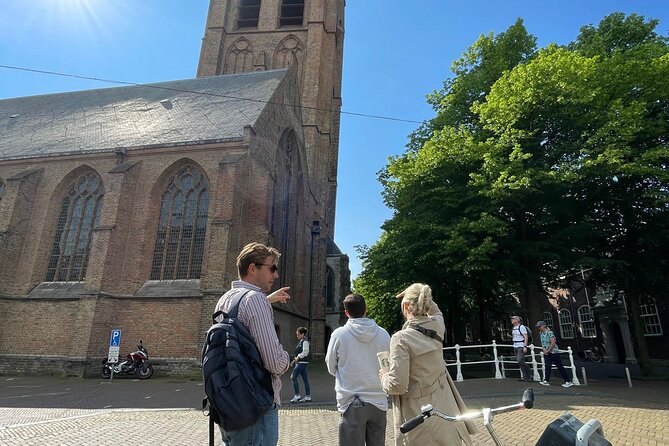
The route then turns back north toward Maria van Jessekerk. The stop takes about 30 minutes and explores the Catholic community of Vermeer’s time.
In the seventeenth century, Catholics in the Dutch Republic often worshipped in hidden churches. The area around Maria van Jessekerk was associated with Catholic life and concealed services, and Vermeer’s mother-in-law’s house was located here. Vermeer lived in that house, and it is generally associated with the place where he made his paintings.
This is a particularly useful stop because it adds domestic detail to the artist’s story. You learn not only where Vermeer painted, but also about the household and religious setting around him.
There is an intriguing uncertainty here. Information from 2023 suggests the house may not have been demolished after all. The guide invites you to look and see whether the curtains are finally open. Treat this as a historical puzzle, not a guaranteed chance to enter or inspect Vermeer’s studio. The value is in understanding the location and the evidence.
Vlamingstraat and the Little Street
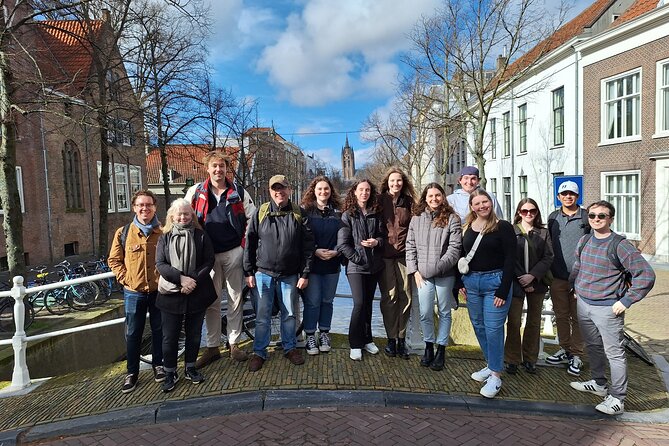
Before entering the museum, you visit Vlamingstraat, where number 42 is now believed to appear in Vermeer’s painting The Little Street. The stop lasts about 15 minutes.
This is another place where the tour encourages you to compare art with the real city. You can look at the street as it is now and consider which parts may connect with the painting. The guide’s wording is important: the identification is presented as a current belief, not an absolute fact.
That careful approach is a strength. Vermeer left few written explanations, and some location studies remain uncertain. A good guide should show you the evidence without pretending every answer is settled.
By this stage, the walk has covered churches, civic buildings, trade, religious life, and specific painting locations. The city begins to feel like a working source of images rather than a backdrop added after the fact.
One and a half hours at the Vermeer Centrum Delft
The walking portion ends at the Vermeer Centrum Delft, housed in the former artists’ guild of Delft. The museum visit is included and comes with an audio guide. Plan about 1 hour and 30 minutes here.
The center focuses on Vermeer’s life and work. The building itself matters because Vermeer was active in Delft’s artists’ guild and eventually became its president. That connection gives the museum a strong local reason for being here.
The museum works best after the walk. You have already seen the streets and buildings, so the paintings and explanations have a physical setting in your mind. Details about Vermeer’s home, religious world, materials, and city view are easier to grasp after you have walked through those places.
The audio guide gives you a more self-directed finish. During the private walk, your guide controls the flow. At the museum, you can spend longer with the subjects that interest you and move more quickly through familiar material.
One practical point: this is the Vermeer Centrum Delft, not the Mauritshuis in The Hague. The experience is about Vermeer’s life and Delft connections, with reproductions and local interpretation rather than a promise to see every original Vermeer masterpiece. If your main goal is original paintings, check your wider Netherlands schedule separately.
Is $232.71 per person a fair price?
At $232.71 per person, this is not a bargain walking tour. The value comes from privacy, a specialist route, church and museum admissions, the audio guide, and the option of hotel pickup and drop-off by car if you choose that package.
For two people, the price becomes a substantial half-day expense. I would consider it more reasonable for committed Vermeer admirers, visitors with limited time, or anyone who wants a guide to handle the connections between locations. Group discounts may improve the cost for larger parties, but the available details do not specify the discount amount.
You also need to account for the difference between the guided walk and the museum visit. The guided portion takes about three hours, while the whole experience runs roughly four to five hours depending on timing. The museum visit follows the walk, so this is not a quick one-hour activity.
If you are content to wander Delft independently and read about Vermeer later, you can spend much less. If you want the burial place, former home area, View of Delft viewpoint, and museum arranged into one private route, the price buys structure and personal attention.
Who should book this Delft experience?
I would choose this tour if you already admire Vermeer or want a clear introduction to his life and city. It also suits couples, families, or small private groups who prefer questions and conversation over a fixed public walking tour.
The experience is not limited to art specialists. The guide also covers William of Orange, Grotius, Van Leeuwenhoek, water management, Catholic life, and Dutch trade. You can enjoy it even if you know only Girl with a Pearl Earring and View of Delft.
The main audience that may hesitate is someone seeking a short museum visit or a large number of original paintings. This route is about places and context. You spend much of the time outside, with the Vermeer Centrum as the final section rather than the entire focus.
The activity is private, and most people can participate. Service animals are allowed. Pickup may be available from a location of your choice, including Amsterdam, but hotel transport is tied to the option you book. The standard meeting point is the Hugo Grotius statue on Markt in Delft.
My booking advice
Book this if the idea of matching real Delft streets to Vermeer’s paintings sounds better than simply looking at them on a wall. The Old Church, Hooikade, Maria van Jessekerk, and Vlamingstraat give the tour its strongest purpose, while the private guide makes it easier to ask about uncertain locations and small details.
I would skip it if your budget is tight, your mobility makes several hours of walking difficult, or you mainly want original Vermeer paintings. For everyone else, this is a focused way to see Delft through one artist’s life, with enough wider Dutch history to make the city feel like more than a pretty canal stop.
Free cancellation is available until 24 hours before the start time. After that cutoff, the payment is not refunded and late changes are not accepted.
FAQ
Where does the Vermeer Delft tour start?
It starts at the Hugo Grotius statue on the Markt, Delft, Netherlands.
Where does the tour end?
The activity ends back at the meeting point in Delft, with the museum visit included as part of the experience.
How long does the experience take?
The experience lasts approximately four to five hours. The guided walking portion takes about three hours, followed by the Vermeer Centrum visit.
Is the Vermeer Centrum Delft admission included?
Yes. Entrance to the Vermeer Centrum Delft is included, along with an audio guide.
Is admission to the Old Church included?
Yes. Admission to the Old Church and New Church is included.
Is this a private tour?
Yes. Only your group participates in the private activity.
Is hotel pickup available?
Hotel pickup and drop-off by car are included if you book the option that offers them. Pickup can also be arranged at a location of your choice, such as Amsterdam.
Can I cancel for a full refund?
Yes, if you cancel at least 24 hours before the experience start time. Cancellations made less than 24 hours in advance are not refunded.
Are service animals allowed?
Yes. Service animals are allowed, and the activity is near public transportation. Most people can participate.
More Rembrandt and Dutch Masters Days
- Vermeer Centrum Delft Museum Admission Ticket
★ 4.0 · 45 reviews - Amsterdam: Rembrandt House Museum Entrance Ticket
★ 4.7 · 3,385 reviews - Amsterdam: Fabrique des Lumières Dutch Masters Ticket
★ 4.6 · 2,373 reviews - Rembrandts Experience Amsterdam Admission Ticket
★ 4.5 · 521 reviews
More Private Tours in The Hague
- The Hague: Old City Private Walking Tour
★ 4.4 · 81 reviews - The Hague: Private Boattour up to 10 persons
★ 4.9 · 37 reviews - Private Walking Tour of Delft: Dive into the Dutch Golden Age
★ 5.0 · 33 reviews - The Hague Private Walking Tour with a Local
★ 4.0 · 29 reviews
Just added around The Hague
- 3 Course Walking Dinner in Delft with Guided Tours in Between★ 5.0 · 3 reviews
- Surfing at The Shore in The Hague★ 4.5 · 3 reviews
- Private Tour of The Hague, Delft and Rotterdam with Lunch★ 5.0 · 3 reviews
- Discover Historical Delft with an Audio Guide★ 5.0 · 3 reviews
- The Hague Self-Guided Audio Tour★ 5.0 · 3 reviews
- Surprise Walk of The Hague with a Local★ 4.5 · 3 reviews
- Private Tour of Rotterdam and The Hague including Transfer★ 5.0 · 3 reviews
- Delft: City Walk with Audio Guide in 7 Languages on your Phone★ 5.0 · 4 reviews
Rembrandt & Dutch Masters Tours, compared.



Rembrandts Experience Amsterdam Admission Ticket
Read our review →
Rembrandt House Museum Amsterdam Entrance Ticket
Read our review →
Van Gogh and Rembrandt Immersive Experience Entry
Read our review →
Rembrandts Immersive Experience Admission Ticket
Read our review →
Browse the lists this tour appears in