
Reviewed · REMBRANDT & DUTCH MASTERS TOURS
Private Walking Tour of Delft: Dive into the Dutch Golden Age
Delft’s story comes into sharp focus on this private walk: a leaning church tower, Vermeer’s grave, William of Orange’s assassination site, and canals built around the constant threat of water. The route links Delft’s Golden Age to the city you see today, rather than treating its old buildings as mere scenery.
I like the private format, which lets your guide adjust the pace for a child, senior, or a group with lots of questions. I also like the useful local advice at the end, when guides such as Robin can point you toward a good beer, snack, dinner, or grocery stop. The main consideration is time: two hours gives you a smart overview, but not long visits inside every landmark.
In This Review
- Key points to know before booking
- Why Delft works so well on foot
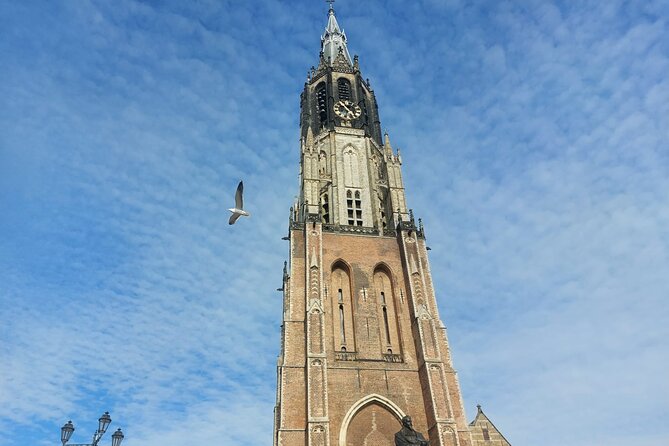
- Starting beside the New Church on Market Square
- Delft Town Hall and the civic side of the city
- The leaning Old Church and Johannes Vermeer
- Prinsenhof and the death of William of Orange
- Oude Delft canal and the water board
- Armamentarium and Delft’s Golden Age
- The former synagogue and Delft’s Jewish community
- Ending at Beestenmarkt with local advice
- Price, group size, and practical value
- Who will get the most from this Delft walk?
- Should you book the Private Walking Tour of Delft?
- FAQ
- Where does the Delft walking tour start?
- Where does the tour end?
- How long does the tour last?
- How many people can join the private tour?
- Is pickup available?
- What is the cancellation policy?
Key points to know before booking
- Eight historic stops: See Delft’s main squares, churches, canals, civic buildings, military sites, and former synagogue.
- Strong historical thread: The walk connects Dutch royalty, Johannes Vermeer, water management, trade, war, and religion.
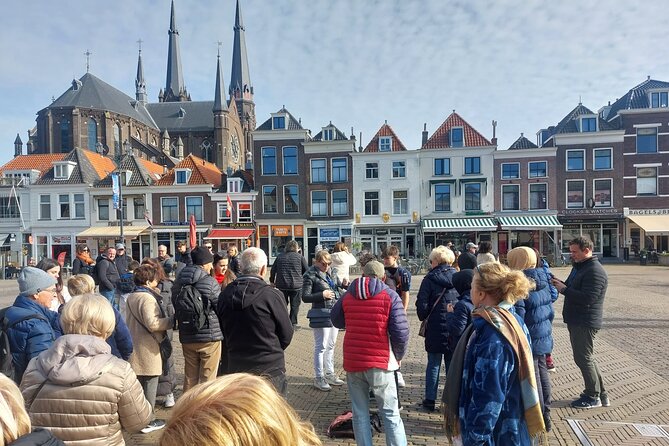
- Private group of up to 15: You receive a personal guide rather than joining a large public group.
- Flexible city-center pickup: You can request pickup from any place in Delft’s city center.
- Guides praised for warmth: Robin and Matyas are named guides who bring humor, clear explanations, and an easygoing style.
- Good finish for the evening: The walk ends at Beestenmarkt, a café-lined square close to the starting point.
Why Delft works so well on foot
Delft is compact, and its historic center rewards a slow walk. Canals cut through streets lined with old houses, while church towers help you keep your bearings. In two hours, you can cross a large part of the old city without wasting time on transport.
This route also gives Delft a useful identity. The city is not only the home of blue-and-white pottery and picturesque canals. It was tied to the Dutch royal family, the Dutch Republic’s military and trading power, the work of water boards, and the paintings of Johannes Vermeer.
I especially like that the walk moves beyond the most obvious postcard views. You will see major landmarks, but you will also pass a former Butter House, an old Weigh House, a historic beer-brewing quarter, the oldest surviving house in Delft, and the site from which Vermeer painted his famous view of the city.
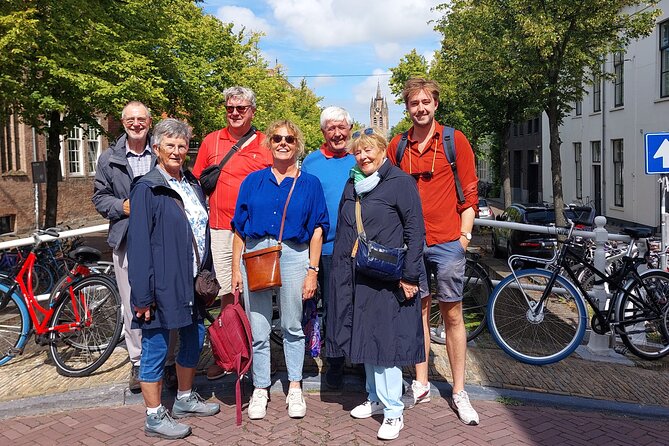
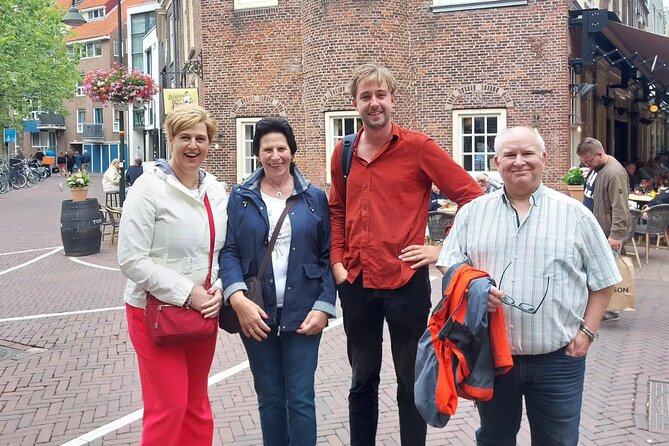
Because the tour is private, you can ask your guide to pause when a detail catches your attention. Robin is described as funny, relaxed, and good at answering questions. Matyas is also praised for making a first visit memorable through stories and a friendly manner. The exact guide depends on availability, but the guiding style appears to lean toward conversation rather than a stiff lecture.
More Private Tours in The Hague
- The Hague: Old City Private Walking Tour
★ 4.4 · 81 reviews - The Hague: Private Boattour up to 10 persons
★ 4.9 · 37 reviews - The Hague Private Walking Tour with a Local
★ 4.0 · 29 reviews
Starting beside the New Church on Market Square
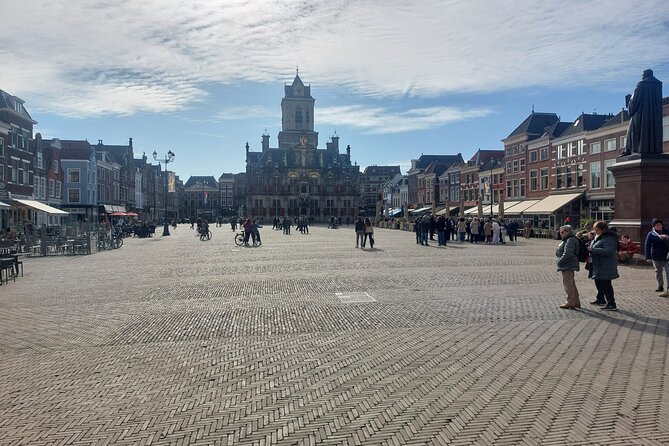
Your meeting point is the Hugo Grotius statue on Markt, Delft’s central Market Square. This is also where the tour ends, making the route easy to understand and convenient if you are planning the rest of your day around the old center.
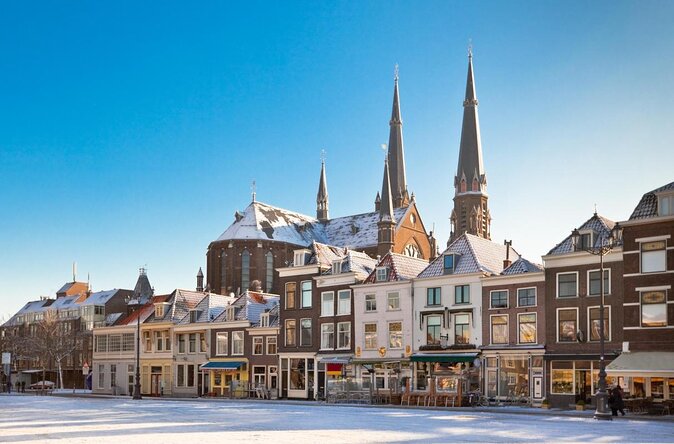
The square is one of the oldest market spaces in the Netherlands. Your guide begins beside the New Church, a landmark that immediately gives you a sense of Delft’s political and religious importance.
The church is the burial place of the Dutch royal family and of Hugo Grotius, the Dutch jurist and thinker whose statue marks your meeting point. Its tower is the second tallest church tower in the country, so it provides an impressive reference point even before you learn the stories behind it.
The stop is planned for about 15 minutes and does not include an admission ticket. That matters if you hoped to climb the tower or spend time inside the church. This experience is primarily an outdoor historical walk, so you should treat the New Church as a setting for interpretation rather than a full church visit.
Delft Town Hall and the civic side of the city
Leaving Markt, your guide passes Delft Town Hall on the way to the Old Church. Its Renaissance façade gives the building a graceful appearance, but the story behind it is less polished.
The Town Hall has been linked to city government, justice, fire, and imprisonment. Your guide explains how a building that looks formal and orderly also reflects the rough work of running a medieval and early modern city.
This is one of the tour’s useful contrasts. Delft’s beauty can make the past seem calm and decorative, yet the town had to deal with crime, political conflict, destructive fires, and the hard business of keeping order.
Again, the planned time is about 15 minutes, and there is no admission fee included because this is a pass-by explanation. If you want to tour the interior, you would need to arrange that separately. For a short introduction, the exterior stop works well because it keeps the walk moving toward the more dramatic Old Church.
The leaning Old Church and Johannes Vermeer
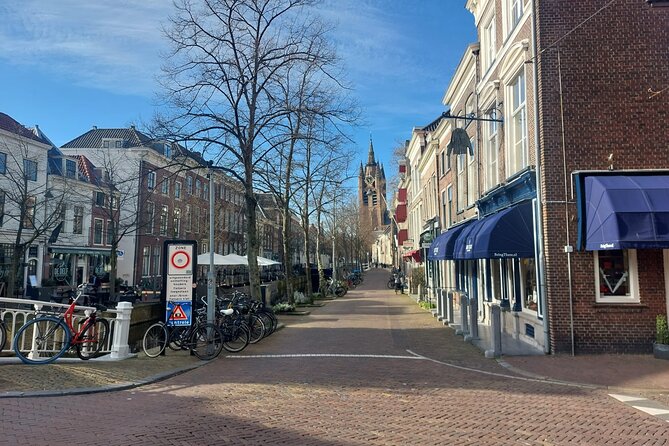
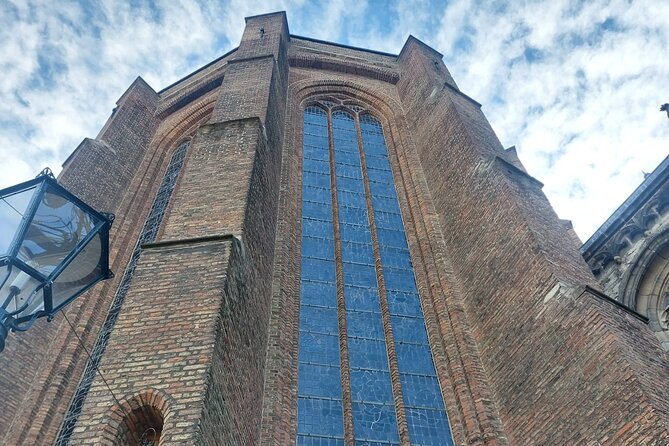
The Old Church is one of Delft’s most memorable sights. Its tower leans so noticeably that you may wonder how it was allowed to remain that way. Your guide explains why the tower began to tilt almost as soon as construction started.
The answer is tied to the ground and the water that have always shaped Delft. You do not need a technical lecture to appreciate the point: building in the Netherlands has long required careful work around soft, wet soil.
Before reaching the church, you pass several smaller pieces of Delft’s past. The former Butter House, old Weigh House, and home associated with Antonie van Leeuwenhoek help show how trade, science, and daily commerce fit into the same narrow streets.
The Old Church was also part of Delft’s former beer-brewing quarter. That detail gives the neighborhood a more everyday feel. You are not simply walking past a famous church. You are crossing an area where people worked, traded, brewed, worshiped, and built their homes.
Inside the church is the grave of Johannes Vermeer, Delft’s best-known painter. The tour does not include admission, so confirm your plans if seeing the interior is important to you. Even from outside, the guide’s explanation helps place Vermeer in the city he painted.
More Walking Tours in The Hague
- Food Walking Tour of The Hague – by Bites & Stories
★ 5.0 · 188 reviews - The Hague: City Walking Tour
★ 4.5 · 156 reviews - The Hague 2-Hour Walking Tour | Discover The City With A Local
★ 4.5 · 81 reviews - The Hague: Courtyard Walking Tour
★ 4.5 · 71 reviews
Prinsenhof and the death of William of Orange
Across from the Old Church, the Prinsenhof carries some of the most serious political history on the route. It began as a monastery and later became a residence for William of Orange, often called the Father of the Fatherland.
William of Orange was assassinated here in 1584. Your guide explains how his death affected the future of the Netherlands and helped connect Delft with the House of Orange.
This stop gives the tour a stronger national frame. The walk is no longer only about Delft’s buildings. It shows how events in one city helped shape the Dutch state.
The Prinsenhof can be a major museum experience in its own right, but this tour treats it as an outdoor historical stop. You will hear the story and see the setting, but admission is not part of the walk. If you have a strong interest in Dutch political history, you may want to return later for a longer visit.
For many people, this is where the value of a private guide becomes clear. The site has an important event attached to it, but the meaning can be lost without context. A good explanation helps you understand why Delft became so closely tied to Dutch royalty.
Oude Delft canal and the water board
The walk continues along the Oude Delft canal, where your guide points out the oldest surviving house in the city. Since 1645, the ornate Gemeenlandshuis van Delfland has housed the local Water Board.
Water boards may sound less exciting than royal tombs or assassinations, but they are central to Dutch history. A water board managed the canals, dikes, drainage, and other systems needed to protect land and homes. In a low-lying country, water management was not a side concern. It affected survival, work, property, and the growth of cities.
This stop adds practical depth to the tour. You learn why Delft’s canals look the way they do and why cooperation between local communities mattered so much. The building itself also gives you a chance to look closely at the decorative architecture along the canal.
The Oude Delft is one of the best parts of the route for simply walking and looking. Historic residences line the water, and the pace here should feel calmer than the central square. If you enjoy architecture and urban design, pay attention to how the canal, houses, bridges, and church towers work together.
Armamentarium and Delft’s Golden Age
Farther south, the walk reaches two strong reminders of Delft’s military and commercial power. The former state weapons armory and the main building of Delft’s chamber of the Dutch East India Company point to the city’s role in the Dutch Republic’s expansion.
Your guide explains how Delft was tied to military supply, maritime trade, and overseas commerce. This is an important correction to the idea that Delft was only an artistic or royal city. Its prosperity was connected to hard, organized work in defense, shipping, and trade.
The tour also brings you near the exact place where Johannes Vermeer stood while painting his famous View of Delft. That detail ties the city’s economic past to its artistic image. You can look at the streets and waterways with the painting in mind, even if the modern view is not identical to Vermeer’s.
The armory and East India Company buildings are exterior sights on the walk. You will spend about 15 minutes at this part of the route, with your guide supplying the story that turns impressive old structures into evidence of Delft’s place in the Dutch Republic.
The former synagogue and Delft’s Jewish community
Walking north along Delft’s second-oldest canal, once used as the city’s grain market, you pass the former synagogue. The building reflects the long presence of a Jewish community in Delft.
This is a quieter stop, but it gives the route needed breadth. Delft’s past included more than royal power, Protestant politics, trade, and famous painters. Religious communities also formed part of the city’s social life.
The synagogue is viewed from the outside, and the planned stop lasts about 15 minutes. Your guide can explain the building’s place in Delft, but the tour does not present it as a full museum visit. I appreciate its inclusion because it keeps the story from becoming too narrow.
Ending at Beestenmarkt with local advice
The tour finishes at Beestenmarkt, a former animal market just behind Markt. Today, it is a pleasant square lined with cafés and restaurants, and it makes a natural place to continue your Delft evening.
Your guide can suggest where to find a good beer, casual food, or a relaxed dinner. One guide also gave practical advice about grocery shopping and dining, which is exactly the sort of small help that can make a short stay easier.
Ending here is more useful than finishing at a random street corner. You return close to where you started, but you also have immediate options for food and a drink. If you are visiting Delft as an afternoon stop, this timing lets you finish the walk and settle into dinner without another transfer.
The route allocates roughly 15 minutes to each of eight stops, although the full experience lasts about two hours. That tells you what to expect: a steady walk with short explanations, not long indoor visits or extended time at one landmark.
Price, group size, and practical value
The price is $203.22 per group of up to 15 people. For one or two people, that is a significant cost compared with a large public walking tour. For a family or group of several adults, the value improves because the price is shared rather than charged per person.
You are paying for a private guide, all fees and taxes, and the ability to shape the conversation around your group. That can be worthwhile if you want to ask questions, move at your own pace, or avoid a crowded tour. It is less compelling if you only want a quick list of sights or plan to spend most of your time inside museums.
Pickup can be arranged from any place in Delft’s city center if you request it. That may save time and hassle, especially if you are arriving with luggage or meeting friends at a central hotel. The published meeting point is already central, so pickup is a convenience rather than a necessity for most people.
The tour is offered in English and uses a mobile ticket. Confirmation is normally provided at booking, though bookings made within one day of the tour are confirmed as soon as possible, subject to availability. Free cancellation is available until 24 hours before the start time. Changes or cancellations inside that window are not accepted for a refund.
Most people can take part, service animals are allowed, and the tour is near public transportation. Since this is a walking experience, wear comfortable shoes and allow enough time to reach the central meeting point.
Who will get the most from this Delft walk?
I would choose this tour for a first visit to Delft, especially if you want the city’s main stories in one clear route. It suits couples, families, and small groups who prefer conversation and flexibility over a fixed public-tour format.
It also works well after time in Amsterdam or The Hague. One group scheduled it late in the day after visiting both cities and still found the walk worthwhile. That said, you should not assume a packed schedule will feel effortless. Two hours on foot after a full day may be tiring, particularly for young children or older adults.
The private setup helps here. A guide such as Robin has been praised for adapting the route when a senior and a small child needed changes. That flexibility is a real advantage, but you should still tell the provider about your group’s needs before the tour begins.
History fans will find plenty to enjoy, from William of Orange and Dutch royal burials to water boards, Vermeer, Jewish heritage, arms, and trade. Food-focused visitors also benefit from the final restaurant and beer suggestions.
You may want something else if your priority is a full museum day, a tower climb, or extended time inside the New Church, Old Church, or Prinsenhof. None of the listed stops includes an admission ticket, and the two-hour schedule is built around outdoor interpretation.
Should you book the Private Walking Tour of Delft?
Book it if you want a well-paced first look at Delft with a private guide who can explain how the city’s art, politics, water, trade, and daily life fit together. The strongest parts are the guide-led stories, the compact route, the Vermeer connections, and the freedom to ask questions.
The price makes the most sense for a group sharing the $203.22 fee. Solo visitors and couples should compare it with public walking tours, but may still prefer the privacy and flexibility.
I would not book it as your only Delft experience if you want lengthy indoor visits. I would book it as your city orientation, then return to the places that catch your eye, particularly the Prinsenhof, Old Church, or New Church.
FAQ
Where does the Delft walking tour start?
It starts beside the Hugo Grotius statue on Markt, at Markt, 2611 GW Delft, Netherlands.
Where does the tour end?
The walk ends back at the original meeting point, near the Hugo Grotius statue on Market Square.
How long does the tour last?
The tour lasts approximately two hours.
How many people can join the private tour?
The price covers one private group of up to 15 people.
Is pickup available?
Yes. Pickup can be arranged from any place in Delft’s city center if you request it.
What is the cancellation policy?
You can cancel up to 24 hours before the experience for a full refund. Cancellations or changes made less than 24 hours before the start time are not accepted for a refund.
More Rembrandt and Dutch Masters Days
- The Hague: Mauritshuis Entrance Ticket
★ 4.7 · 2,706 reviews - Vermeer Centrum Delft Museum Admission Ticket
★ 4.0 · 45 reviews - Amsterdam: Rembrandt House Museum Entrance Ticket
★ 4.7 · 3,385 reviews - Amsterdam: Fabrique des Lumières Dutch Masters Ticket
★ 4.6 · 2,373 reviews
Just added around The Hague
- The Hague: Street Art Tour by Bike★ 4.8 · 30 reviews
- Vermeer Centrum Delft Museum Admission Ticket★ 4.0 · 45 reviews
- The Hague Tower Guided Tour★ 4.5 · 45 reviews
- Scheveningen Beach: 2-Hour Surf Experience for Adults★ 4.8 · 50 reviews
- Walking Tour of Delft – The City of Orange and Blue★ 5.0 · 50 reviews
- The Hague: One Way Boat Ticket to or from Delft★ 4.5 · 52 reviews
- The Hague: Courtyard Walking Tour★ 4.5 · 71 reviews
- The Hague: Beginner’s Surf Lesson★ 4.7 · 78 reviews
Rembrandt & Dutch Masters Tours, compared.



Rembrandts Experience Amsterdam Admission Ticket
Read our review →
Rembrandt House Museum Amsterdam Entrance Ticket
Read our review →
Van Gogh and Rembrandt Immersive Experience Entry
Read our review →
Rembrandts Immersive Experience Admission Ticket
Read our review →
Browse the lists this tour appears in