
Reviewed · MUSEUMS
The Hague: Escher in The Palace Museum Ticket
M.C. Escher’s art turns ordinary reality into a puzzle, and Escher in Het Paleis lets you see that effect in the rooms of a real former palace. The star is Metamorphosis III, a seven-meter woodcut that links changing patterns, time, and space across a huge wall. You’ll also find Day and Night, Climbing and Descending, and more than 130 prints.
I like the clear story of Escher’s artistic development, from detailed early work to the tessellations and impossible buildings that made him famous. I also like the interactive top floor, where you can test optical tricks with your hands and eyes instead of simply reading about them. The main drawback is that some rooms are small and can feel stuffy when the museum is busy, while the dim lighting may make certain labels harder to read.
In This Review
- Key points to know before you go
- Seeing Escher inside a former royal residence
- Following Escher’s artistic development
- The famous impossible worlds
- Metamorphosis III and the power of scale
- Looking as Escher Does on the top floor
- The palace details are part of the exhibit
- How long to plan and how to use the audio guide
- Is the $15 admission good value?
- A practical visit for families and day trips
- Who will enjoy Escher in Het Paleis most?
- Should you book this Escher museum ticket?
- FAQ
- Where is Escher in Het Paleis located?
- How do I reach the museum from The Hague Central Station?
- What does the admission ticket include?
- How long is the museum visit?
- Is the museum suitable for children?
- Is a guided tour included?
- Can I bring luggage or large bags?
Key points to know before you go
- Metamorphosis III stretches seven meters across the gallery, giving Escher’s changing patterns room to unfold.
- The museum occupies Queen Mother Emma’s former Winter Palace, with royal details still visible throughout the building.
- More than 130 prints cover Escher’s career, including tessellations, landscapes, portraits, and impossible architecture.
- The top-floor Looking as Escher Does exhibition is hands-on, with puzzles and optical illusions for children and adults.
- A multilingual audio guide is included in English, Dutch, German, French, Chinese, Japanese, Ukrainian, and Korean.
- The $15 ticket is valid for 365 days, with free cancellation up to 24 hours before the visit and a reserve-now, pay-later option.
Seeing Escher inside a former royal residence
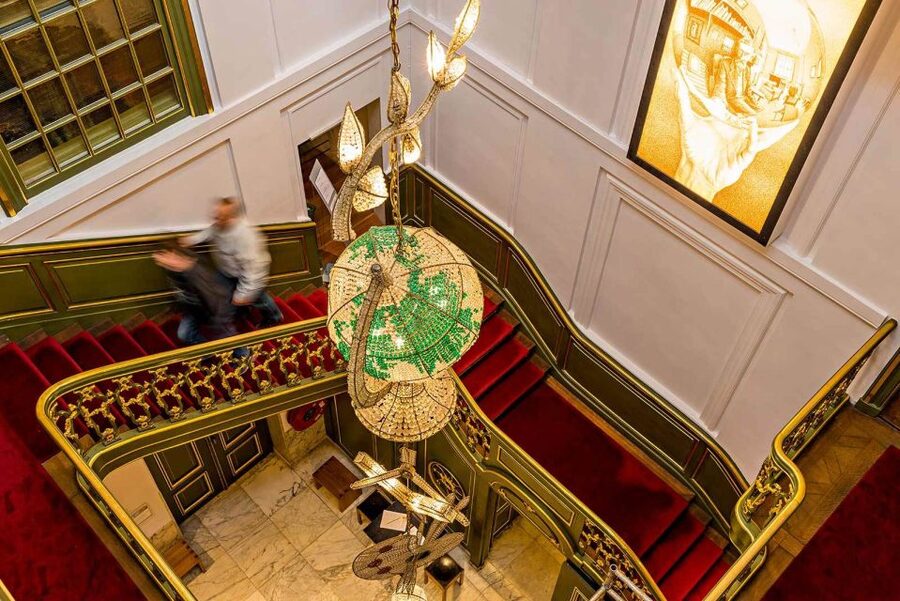
The setting changes the mood before you even reach the artwork. Het Paleis occupies the former Winter Palace of Queen Mother Emma of the Netherlands, and it is the only public building in The Hague where the original royal atmosphere has been maintained.
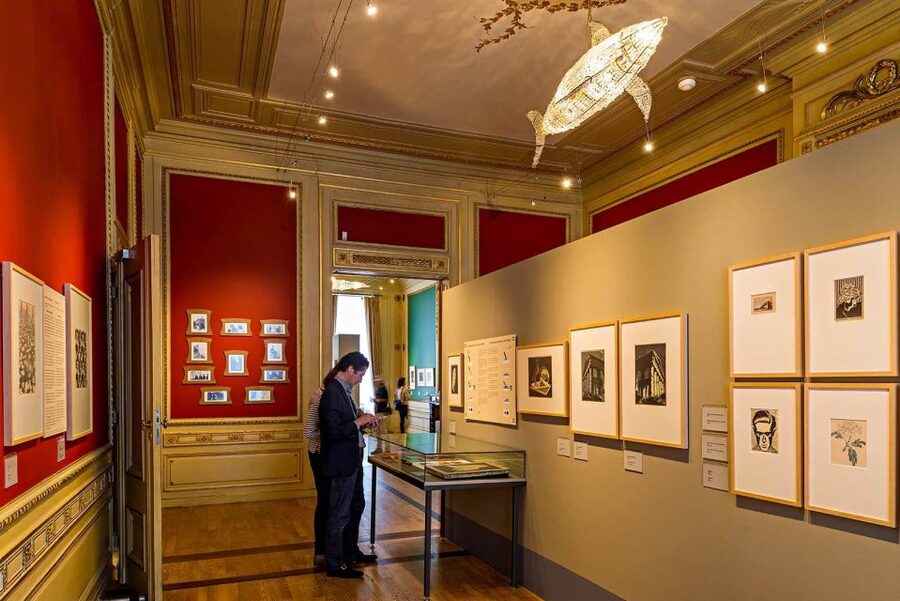
That does not mean you are walking through a fully furnished royal home from room to room. Instead, Escher’s work shares the building with details from its palace past. Look up as you move through the galleries. The ceilings, floors, chandeliers, and room proportions all add another layer to the visit.
I enjoy this contrast. Escher’s prints can feel mathematical, strange, and almost detached from daily life. The palace rooms bring them back into a human setting. You are looking at visions of infinity and impossible staircases in spaces once used by Dutch royalty.
The museum is at Lange Voorhout 74 in The Hague, a central location near parks, the Binnenhof area, and the Hofvijver. From The Hague Central Station, tram 9 stops at Korte Voorhout, while tram 17 stops at Kneuterdijk. That makes this an easy addition to a day in the city.
More Entry Tickets in The Hague
- The Hague: Mauritshuis Entrance Ticket
★ 4.7 · 2,706 reviews - The Hague: Madurodam Miniature Park Entry Ticket
★ 4.6 · 1,559 reviews - The Hague: The Pier SkyView Ticket with Drink and Snack
★ 4.4 · 1,398 reviews
Following Escher’s artistic development
The museum works best when you do not rush straight to the famous optical illusions. Escher became widely known for images that seem to break the rules of nature, but the collection also shows how he arrived there.
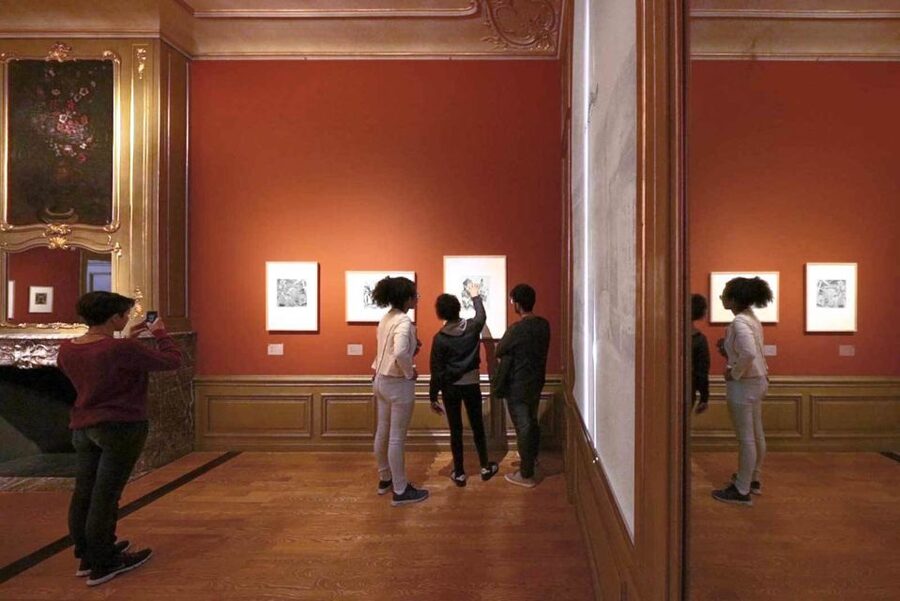
You can trace his interest in careful observation, pattern, architecture, and the natural world. The collection includes much more than staircases and black-and-white creatures. You might find detailed prints, repeated forms, tessellations, and earlier work that helps explain the later mathematical direction of his art.
This progression gives the visit more substance than a quick gallery of popular images. I like seeing how Escher returned to certain ideas, tested them in different forms, and gradually developed the visual language now associated with him.
If you already know his work from books, posters, or school art classes, the original prints let you study the fine detail. Lines that look simple at a distance can become extremely precise when you stand close. If Escher is new to you, the exhibition gives enough background to make the famous pieces easier to understand.
The museum also explains Escher’s interest in mathematics. You do not need a technical background to follow the basic ideas. The displays connect his repeated shapes and visual tricks to the way he studied order, symmetry, and transformation.
The famous impossible worlds
Several of Escher’s best-known images are here, and these are the works most people come hoping to see.
In Day and Night, a Dutch scene appears to change into a flock of birds. The image is carefully balanced, so the transition feels natural even though the idea is impossible. You can spend a long time moving your eyes across the print, watching one form become another.
Climbing and Descending is another major attraction. Rows of figures move endlessly up and down a staircase, creating a loop with no real beginning or end. The scene looks orderly at first, then becomes unsettling as you realize that the people can never reach a final floor.
These works are popular for good reason, but they make more sense after you have seen some of Escher’s other studies. The museum gives you the chance to compare his famous impossible spaces with his more observational and decorative work.
I recommend standing back from the best-known prints first, then moving closer. From a distance, you see the overall trick. Up close, you notice the control of line, texture, and repeated detail that makes the illusion work.
Metamorphosis III and the power of scale
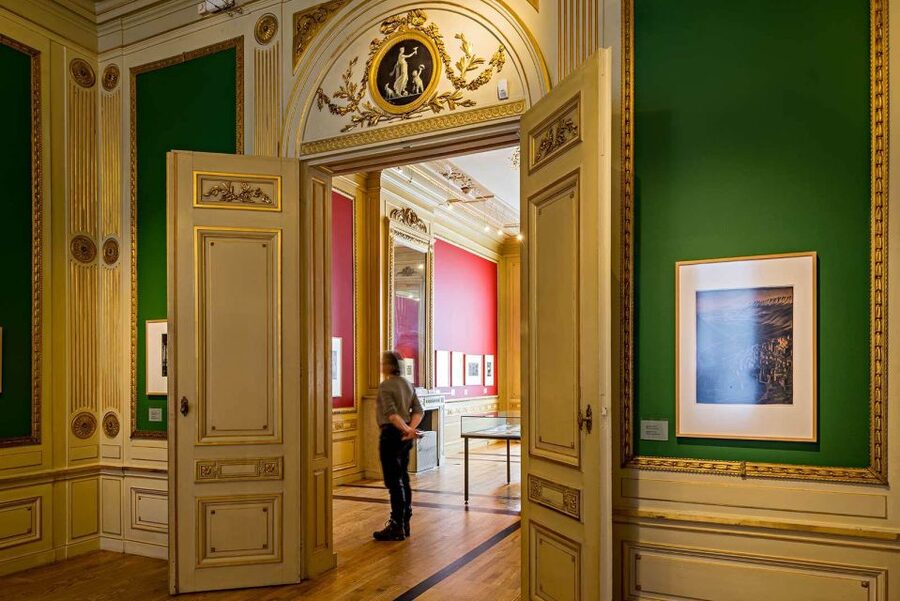
Metamorphosis III is the piece that gives the exhibition its biggest visual moment. At seven meters long, it is far larger than the prints most people associate with Escher.
The work changes from one form to another across the length of the image. Patterns connect time and space as an organic sequence, so you do not view it as a single frozen scene. The unconventional display lets you experience the full movement of the design rather than seeing only one section at a time.
This is where the size matters. In a book or online image, you can understand the concept, but the physical scale shows how much planning went into the work. Allow yourself time to follow the changes from one end to the other.
The gallery may attract a crowd because this is one of the museum’s signature pieces. If you want a quieter look, spend time with the smaller works first and return to Metamorphosis III later.
More Museum Tours in The Hague
- Royal Delft: Delftblue Factory and Museum Admission Ticket
★ 4.5 · 145 reviews - The Hague: Panorama Mesdag Museum Entry Ticket
★ 4.8 · 143 reviews - The Hague: Prison Gate Museum
★ 4.5 · 58 reviews - Vermeer Centrum Delft Museum Admission Ticket
★ 4.0 · 45 reviews
Looking as Escher Does on the top floor
The interactive section, Looking as Escher Does, is one of the strongest reasons to bring children. It is not just a room with a few buttons. The displays use puzzles for your eyes and hands to show how Escher’s visual ideas function.
You can test perception, patterns, and impossible forms in a more active way than in the print galleries. This helps children understand why an image looks wrong even when every individual line seems carefully drawn.
Adults should not skip this floor. Escher’s work can leave you wondering how the illusion was built, and the interactive displays offer a practical way to examine those tricks.
Families can also pick up the free treasure hunt for children. It gives younger visitors a reason to look closely at the rooms and artwork. The museum has a family-friendly feel without reducing the art to a children’s attraction.
The upper floor is a particular highlight, but keep an eye on the closing time. One visitor found the area so engaging that more time would have been welcome before the museum closed at 5 p.m. Check the current opening hours when planning your day.
The palace details are part of the exhibit
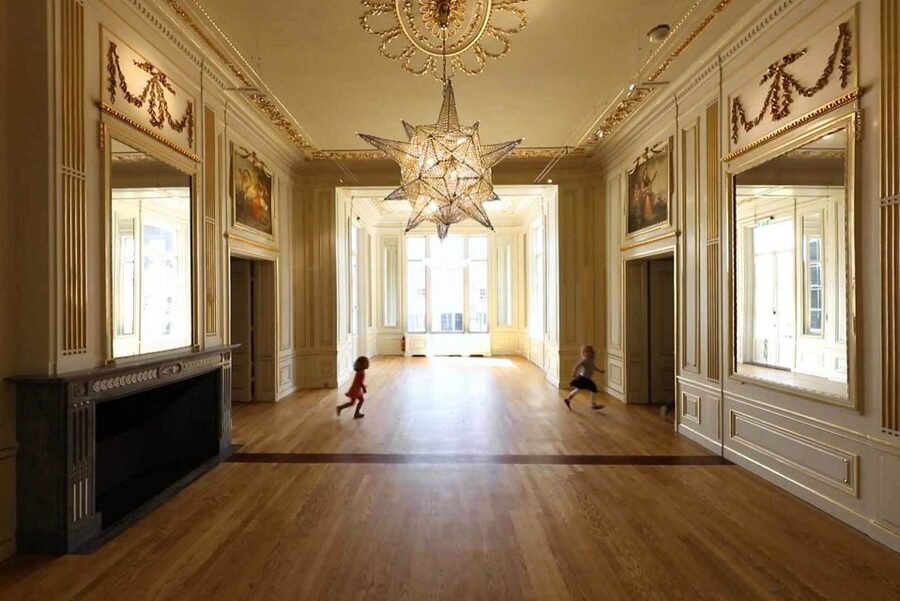
The artwork receives most of the attention, but the building rewards slow looking. Chandeliers are worth special attention, and one useful tip is to keep looking above eye level as you move through the museum.
The palace setting also gives you a glimpse of how the Dutch royal family lived. You are not visiting a separate royal palace museum with a full political story, but the rooms and fittings provide a small window into royal domestic life.
This combination suits anyone who likes architecture as much as art. Escher’s prints are displayed in rooms that have their own visual character, and the result feels more personal than a modern white-walled gallery.
The building is beautiful, but it has limits. Several rooms are relatively small, and ventilation can be less comfortable when visitor numbers rise. The lighting is intentionally subdued in parts of the museum, which protects the atmosphere but can make some labels tiring to read.
How long to plan and how to use the audio guide
The museum is a manageable size. For a brisk visit, plan on about an hour. I would allow one and a half to two hours if you want to read the background material, follow Escher’s development, study the major prints, and spend time with the interactive displays.
The audio guide is included in eight languages: English, Dutch, German, French, Chinese, Japanese, Ukrainian, and Korean. It can add useful context, especially if you want more information about Escher’s life and artistic choices.
You can also visit without relying on audio. The works have descriptive information in English and Dutch, so you can move at your own pace. If you prefer not to spend time setting up a phone-based guide or sharing personal information for an app, the printed explanations may be enough.
I would begin with the introductory material or video about Escher’s life. It helps set the tone for the rest of the visit and makes the changes in his work easier to follow. Then take the galleries in order before ending on the interactive floor.
Is the $15 admission good value?
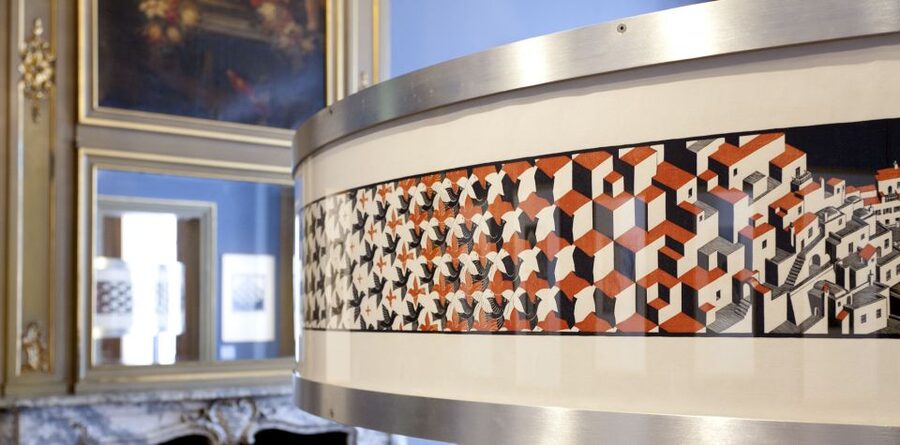
At $15 per person, this is a reasonable cultural stop, especially if you already like Escher or want an indoor activity that works for several age groups. You are paying for more than a single room of famous prints. The admission covers a large permanent collection, the palace setting, the interactive displays, and the included audio guide.
The value is strongest for people who plan to spend at least an hour looking carefully. If you only want a quick photograph of one famous image, the price may feel less compelling. The museum is small enough to visit efficiently, but it has enough detail to reward a slower pace.
The ticket is listed as valid for 365 days, though you still need to check availability and starting times when booking. The reserve-now, pay-later option is useful if your Hague plans may change, and cancellation is free up to 24 hours in advance.
A guided tour is not included. A private guide for a group of up to 20 people costs EUR 60 per guide and must be reserved in advance. For most independent visitors, the displays and audio guide should provide enough structure. A guided visit may make sense for a school group, art class, or larger party that wants a more formal explanation.
A practical visit for families and day trips
The museum fits neatly into a day trip from Amsterdam. You can combine it with other sights in The Hague, walk around the Hofvijver, see the Parliament buildings, and choose from nearby lunch spots.
The central setting also means you do not need to build an entire day around the museum. If you are interested in art, Escher in Het Paleis can fill a couple of hours. If you are exploring The Hague with children, the treasure hunt and hands-on displays make it an easy stop between outdoor sights.
Children up to age six enter free when accompanied by a paying adult. Larger bags and luggage are not allowed inside, so plan to store them elsewhere before arriving. The museum has lockers for bags, but you should avoid arriving with more luggage than necessary.
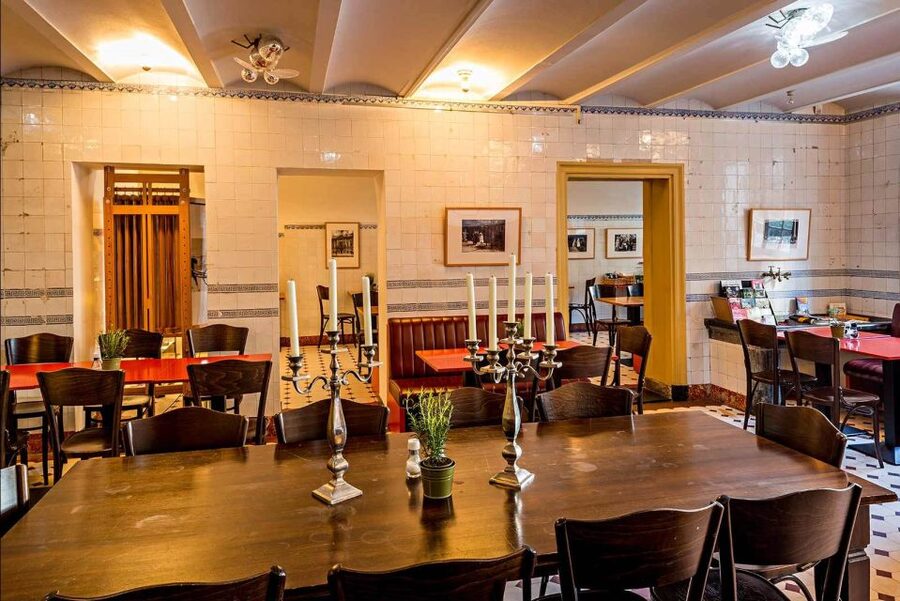
The palace café, located in the former kitchen, gives you a place to pause after the galleries. It is a pleasant detail, though you should treat it as a museum café rather than the main reason to visit.
The Palace is closed on Christmas Day and January 1. It remains open on Easter, King’s Day, Ascension Thursday, Whitsun, and Whit Monday, according to the stated holiday schedule.
Who will enjoy Escher in Het Paleis most?
I would choose this museum for several types of visitors:
- Escher fans who want to see original prints and follow the artist’s changing ideas.
- Families looking for puzzles, visual tricks, and a free children’s treasure hunt.
- Design, architecture, and graphic art students interested in pattern, perspective, and repetition.
- First-time visitors to The Hague who want a central indoor attraction with a strong sense of place.
- Adults who prefer focused museums rather than huge collections that require an entire day.
It is less suited to someone looking for a broad survey of Dutch art. This is a specialist museum built around one artist, and the palace is a setting rather than a separate major collection of royal treasures.
I also would not rush here if your schedule allows only a few minutes. The famous works are impressive, but the best part is seeing how the ideas connect across the exhibition.
Should you book this Escher museum ticket?
Book it if you enjoy visual puzzles, graphic art, mathematics, or unusual historic buildings. The collection is broad enough for serious Escher fans, while the interactive floor and treasure hunt give families plenty to do.
I especially like the balance between the original artwork and the palace setting. You get the famous impossible scenes, but you also see less familiar work and learn how Escher developed his style. The $15 price is fair for a visit that can fill one to two hours without demanding a full day.
Skip it only if you have little interest in Escher or need a large, traditional art museum. For everyone else, this is one of The Hague’s most distinctive indoor stops, with enough visual surprises to keep both adults and children looking twice.
FAQ
Where is Escher in Het Paleis located?
The museum is at Het Paleis, Lange Voorhout 74, The Hague, in South Holland, Netherlands.
How do I reach the museum from The Hague Central Station?
Take tram 9 to Korte Voorhout or tram 17 to Kneuterdijk.
What does the admission ticket include?
The ticket includes admission to Escher in Het Paleis and an audio guide in English, Dutch, German, French, Chinese, Japanese, Ukrainian, or Korean.
How long is the museum visit?
The ticket itself is valid for 365 days, but the visit length is not fixed. Plan on about one hour for a quick visit, or one to two hours if you read the displays and use the interactive exhibits.
Is the museum suitable for children?
Yes. Children can use the interactive Looking as Escher Does exhibition and take part in a free treasure hunt. Children up to age six enter free with a paying adult.
Is a guided tour included?
No. A guided tour for up to 20 people costs EUR 60 per guide and must be reserved in advance.
Can I bring luggage or large bags?
No. Luggage and large bags are not allowed inside the museum.
More Museums and Galleries in The Hague
- Amsterdam: Van Gogh Museum Ticket
★ 4.7 · 52,054 reviews - Moco Museum Amsterdam Entrance Tickets with Banksy & More
★ 4.4 · 10,088 reviews - Amsterdam: The Upside Down Museum Entrance Ticket
★ 4.4 · 9,506 reviews - Amsterdam: Red Light Secrets Museum Entry Ticket
★ 4.2 · 5,722 reviews
Just added around The Hague
- The Hague: Street Art Tour by Bike★ 4.8 · 30 reviews
- Vermeer Centrum Delft Museum Admission Ticket★ 4.0 · 45 reviews
- The Hague Tower Guided Tour★ 4.5 · 45 reviews
- Scheveningen Beach: 2-Hour Surf Experience for Adults★ 4.8 · 50 reviews
- Walking Tour of Delft – The City of Orange and Blue★ 5.0 · 50 reviews
- The Hague: One Way Boat Ticket to or from Delft★ 4.5 · 52 reviews
- The Hague: Courtyard Walking Tour★ 4.5 · 71 reviews
- The Hague: Beginner’s Surf Lesson★ 4.7 · 78 reviews
Museums, compared.
Moco Museum Amsterdam Entrance Tickets with Banksy & More
Read our review →


Amsterdam’s Weirdest Museum: Believe It or Not!
Read our review →

Browse the lists this tour appears in