
Reviewed · HISTORICAL TOURS
Discover Historical Delft with an Audio Guide
William of Orange was murdered in Delft, and this tour does not skip the ugly part: you will hear how the assassination happened and what was done to the killer. You will also track down the modern mystery of the house where Johannes Vermeer painted his famous scenes. Delft’s stories are often tucked behind quiet facades, and this route helps you notice them.
I like the freedom to pause for a beer in the Markt square and continue when you are ready. I also like the light, humorous tone and the fact that the tour works without an internet connection after activation. The main drawback is simple: this is an audio walk, not a live tour, so you will not have a person beside you to answer questions or adjust the pace.
In This Review
- Key points at a glance
- Why Delft works so well as an audio walk
- Starting at Prinsenhof and William of Orange’s murder
- The Old Church and Delft’s smallest museum
- The water board and the oldest house
- A girls’ orphanage, an old tree, and a microbiology pioneer
- Crossing the Markt to Delft’s grand civic center
- The New Church and the Dutch royal connection
- Vermeer, the Maria van Jessekerk, and an unresolved address
- Delft’s only synagogue and a changing city
- Armamentarium and Delft’s southern view
- The VOC office and Delft’s commercial power
- What $22 gets you
- Who should choose this Delft tour?
- Should you book it?
- FAQ
- Where does the audio tour begin?
- Where does the tour end?
- How long does the tour take?
- Does the tour require an internet connection?
- What do I need to bring?
- Are admission tickets included?
- Is this a private tour?
- Can I cancel for a full refund?
- Is the tour available every day?
Key points at a glance
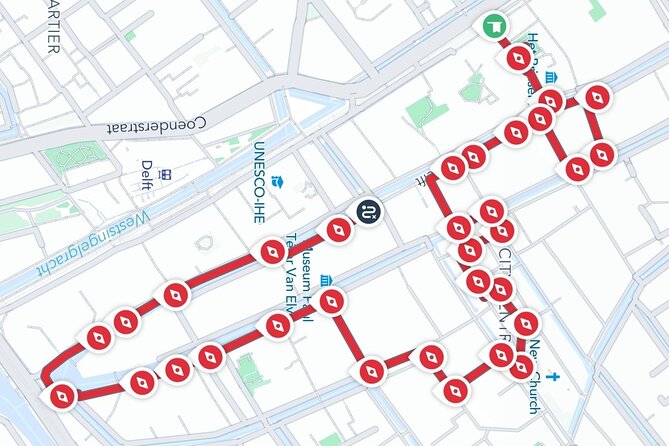
- A 10-stop route through central Delft: Walk from Museum Prinsenhof to the former Dutch East India Company office on Oude Delft.
- History with a sharp edge: Learn about William of Orange’s assassination, the punishment of his killer, and the power of the Dutch East India Company.
- Vermeer without guesswork: Hear about the actual house where Johannes Vermeer made his paintings and view Delft from the same southern side shown in his famous painting.
- Useful offline format: Activate the tour, follow the GPS directions, and pause or resume whenever you like without needing mobile internet.
- Strong value at $22: The tour offers lifetime access and about two hours of city sightseeing, but you supply your own smartphone and headphones.
- A flexible independent outing: You can stop for a drink, take photos, or linger at the Markt without holding up a group.
Why Delft works so well as an audio walk
Delft is compact, handsome, and full of details that are easy to miss if you simply follow the canals toward the main square. This route gives you a reason to slow down. Instead of seeing only attractive brick buildings and church towers, you get stories about water management, orphanages, weapons, pottery, science, religion, painting, and student life.
The experience is GPS-based, so the audio begins as you reach the relevant parts of the route. That matters in Delft, where several important sights sit close together but do not always explain themselves from the street. You can look at a leaning church tower while hearing why it leans, then move on to the oldest water board building in the city.
The tone is designed to be easygoing rather than solemn. The supplied description promises humor along with the facts, and that balance is useful here. Delft has plenty of grand history, but it also has odd details, local mysteries, and the traces of ordinary businesses that once made the city wealthy.
You need your own smartphone and headphones. After you activate the code and download what is needed, the route does not require an internet connection. That makes it practical for visitors who do not want to use mobile data or stop constantly to check a map.
More history walks around The Hague:
- The Hague: Hop-on Hop-off Old-Fashioned Heritage Tram Tour
★ 4.4 · 1,083 reviews - Photographic Tour in Delft Historical Center
★ 5.0 · 11 reviews - Historical The Hague: Private Tour with Local Guide
★ 5.0 · 6 reviews
Starting at Prinsenhof and William of Orange’s murder
The route begins at Phoenixstraat 42, near Museum Prinsenhof Delft. The first section takes about 15 minutes and leads through the Prinsenhof garden.
This is an excellent opening because the setting connects directly to one of the Netherlands’ most important political stories. William of Orange, often called the Father of the Fatherland, was assassinated in Delft. The audio explains who he was, how the murder took place, and what happened to the killer afterward.
That last detail gives the stop a darker edge. You are not getting a vague account of a famous death. The tour promises the full sequence, including the punishment handed down after the assassination. If you prefer history with its rough corners left intact, this is one of the route’s strongest moments.
Admission to the museum is not included, and the tour is designed around the outside and garden area rather than a museum visit. You should treat the Prinsenhof stop as a historical introduction, not as a substitute for touring the collections inside.
The Old Church and Delft’s smallest museum
From Prinsenhof, the route continues to the Old Church, or Oude Kerk. Allow about 10 minutes here. You will see the church from several angles and hear about its most famous physical feature: the tower is leaning.
The leaning tower is an easy photo stop, but the audio gives you a reason to look beyond the novelty. In a city where canals, old houses, and church towers can begin to blur together, a clear explanation helps turn the view into a memorable place.
The next section takes you toward the Gemeenlandshuis van Delfland, with a brief look at what is described as Delft’s smallest museum. The tour does not treat museums as isolated buildings. Instead, it points out a tiny cultural stop along the street, then connects it to the city’s larger story.
That approach suits Delft. You do not need to spend an entire afternoon inside every building to understand the city. A short explanation at the right spot can be enough to make a small doorway, facade, or odd collection worth noticing.
The water board and the oldest house
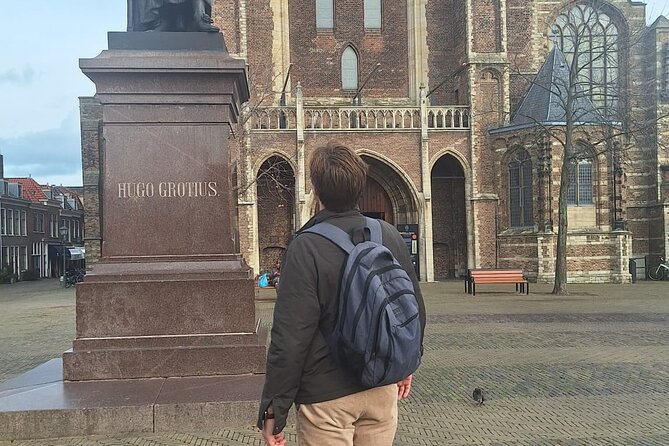
The Gemeenlandshuis van Delfland receives about five minutes. Its facade is impressive, but the useful question is what the building actually did.
Since 1645, it has been connected with Delft’s water board. That may sound less glamorous than royal burials or famous painters, but water control is central to Dutch life. The building gives you a glimpse of the practical systems that helped manage the country’s waterways.
I especially like the inclusion of this stop because it broadens the tour beyond the usual Delft checklist. You are not only hearing about churches and Delft Blue pottery. You are also learning how civic institutions shaped the city.
The tour describes this as the oldest house of Delft. Since the stop is short, you should expect an explanation from the street rather than a long architectural lecture. It is a quick but worthwhile pause between the better-known landmarks.
A few more The Hague half-days to weigh up
- Discover The Hague with a self-guided Outside Escape city tour
★ 4.5 · 35 reviews - Discover Delft with a self-guided Outside Escape city game tour!
★ 5.0 · 32 reviews - e-Scavenger hunt Delft: Explore the city at your own pace
★ 4.5 · 26 reviews - Hague: The Heart of Old Town Exploration Game and Tour
★ 3.5 · 25 reviews
A girls’ orphanage, an old tree, and a microbiology pioneer
At Sociëteit het Meisjeshuis, the route spends roughly 10 minutes. The building was once a girls’ orphanage, and its garden contains Delft’s oldest tree.
The stop also introduces the man depicted on the fence, described as the grandfather of microbiology. This refers to the story of the person who discovered a hidden world full of little animals. The audio uses that vivid idea to connect a Delft location with early scientific observation.
This is the kind of detail that makes an audio tour useful. You might walk past a fence or garden without knowing why a particular figure appears there. The narration gives the site a human and scientific angle, while the old tree adds a small piece of local character.
You should not expect a major museum visit at this point. The value comes from the combination of the former orphanage, the tree, and the scientific connection. It is a short stop, but it helps show how Delft’s story extends beyond politics and art.
Crossing the Markt to Delft’s grand civic center
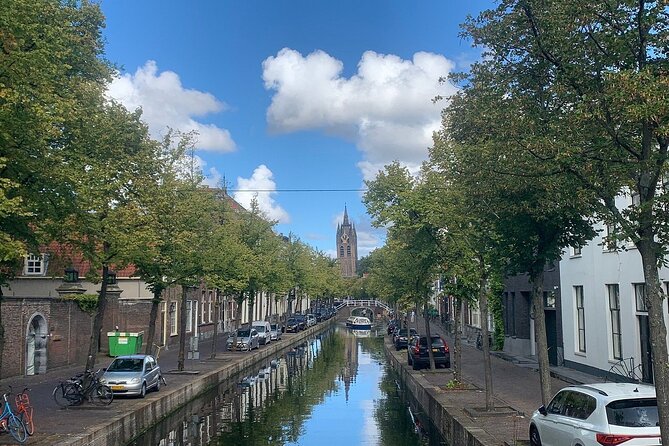
The route then heads toward Stadhuis Delft, or Delft Town Hall. The 15-minute section passes the Boterbrug, the Meat Hall, the Weighing House, the Butter House, and the country’s oldest chemist before reaching the town hall.
This stretch is one of the best parts for understanding how the old city worked. The names of the buildings point to trade, food, measurement, and local services. Delft was not simply a pretty place for painters and princes. It was also a working commercial town.
Town Hall faces the Markt square and presents a strong example of Dutch Renaissance design. The wide square gives you room to appreciate the building, take photos, and get your bearings. Since the route later returns to this area, you can also use the Markt as a natural break.
The audio tour does not force you to keep moving. One of the best practical features is the pause button. Stop for a drink, browse around the square, or take a few minutes to look at the surrounding facades before continuing.
The New Church and the Dutch royal connection
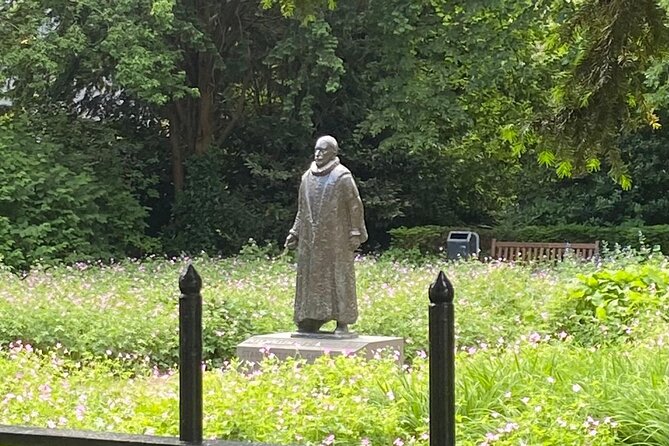
Across the Markt stands the Nieuwe Kerk, or New Church. Despite its name, it is not new. The stop takes about 10 minutes and covers the church’s long history, its royal burials, and the person represented by the statue nearby.
The church is described as the second-tallest in the country. It is also where members of the Dutch royal family are buried, giving the building a national importance that goes beyond Delft itself.
The route adds that the church has welcomed famous American visitors. You will need to take the tour to hear that story, but the detail suggests the narration is not limited to a standard list of dates and architectural labels.
Admission is not included. If you want to enter the church, plan to pay separately and allow extra time. If you stay outside, the audio still gives the Markt and church a useful place in Delft’s political and royal story.
Vermeer, the Maria van Jessekerk, and an unresolved address
After the Markt, the route moves to the Maria van Jessekerk for about 10 minutes. This stop follows the discussion of the real house where Johannes Vermeer made his paintings.
That wording is important. You are not just hearing a general account of Vermeer’s life. You are being directed toward a modern mystery involving the actual house associated with his work. The audio makes the point that the house is known, but the connection still raises questions about how Vermeer used the space and created the scenes now seen in museums around the world.
The Maria van Jessekerk adds another church to the route. That might sound repetitive after the Old Church and New Church, but each building helps show Delft’s religious and architectural variety.
The tour does not include admission to any of the churches. You can still appreciate their exteriors, but check locally if you want to enter. The route’s central promise is the walking narrative, not a package of interior visits.
Delft’s only synagogue and a changing city
The stop at Vrienden van de Synagoge Delft takes around 10 minutes. Here you return to Delft’s oldest canal and see the city’s only synagogue.
The audio highlights an important architectural fact: this was the first synagogue in the Netherlands designed by a Jewish architect. That gives the building a place in both Delft’s history and the wider story of Jewish life in the Netherlands.
This is another stop where the audio adds context that a quick photograph cannot provide. From the street, the synagogue may look like one more historic building along the canal. The narration helps you understand why it matters.
The route remains focused and manageable. You are not asked to cross the city repeatedly, and the stops stay within a walkable central area. Still, two hours can pass quickly once you stop for photos or spend extra time in a church or square.
Armamentarium and Delft’s southern view
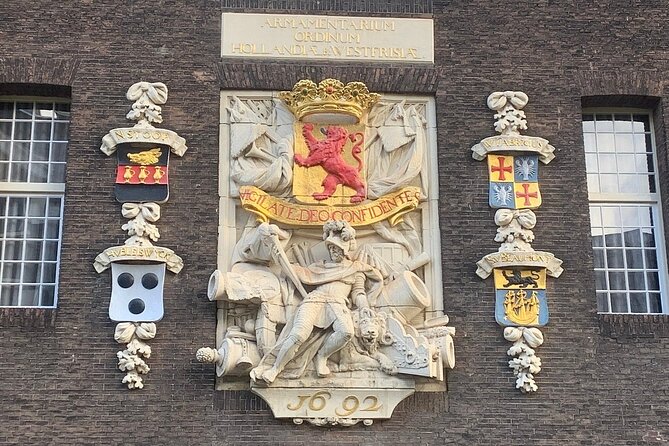
Continuing south, you pass former Delft Blue pottery manufacturers before reaching the Armamentarium. This building was once the weapons arsenal of Holland, and the stop takes about 15 minutes.
The pottery connection is essential to Delft’s identity. The tour explains how the Dutch copied a Chinese product and developed the famous Delft Blue tradition. That story places local ceramics within global trade and fashion, rather than treating blue-and-white pottery as an isolated craft.
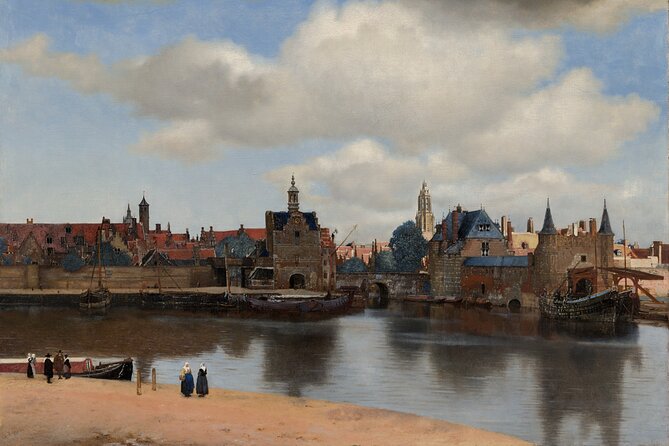
At the Armamentarium, the audio also discusses Vermeer’s View of Delft. The painting shows the city from the south, so this location offers a useful way to connect an actual street position with one of the most famous images of Delft.
The tour cannot promise the exact visual conditions shown in the painting, and it does not include museum admission. What it can do is give you a stronger sense of direction. You understand that View of Delft was not an invented cityscape. It was based on a real approach to the city.
The VOC office and Delft’s commercial power
The final stop is VOC-Kamer Delft, the former Delft office of the Dutch East India Company. Allow about 10 minutes.
The Dutch East India Company, known as the VOC, helped make Delft wealthy. The audio explains the company’s role and why some people consider it the biggest company ever. The subject is important because it connects the city’s fine pottery, trade, wealth, and international reach.
This part also adds needed balance to the tour’s more picturesque moments. Delft’s canals and painted houses are attractive, but the city’s prosperity depended on commerce and overseas networks. The former VOC office is a good place to think about that larger story.
The route ends at Oude Delft 72, in the middle of the city. From there, you are a short walk from the Markt and the train station. That makes the finish convenient if you want to continue sightseeing, have a meal, or leave Delft by rail.
What $22 gets you
At $22, the main value comes from the amount of independent sightseeing packed into about two hours. You get 10 stops, directions to the starting point, an activation code, offline use, and lifetime access.
That lifetime access matters if you are staying nearby or expect to return to Delft. You can also stop partway through and continue later instead of treating the route as a single uninterrupted walk.
The price is fair if you want structure but do not need a live guide. A private walking tour would normally offer conversation and flexibility in a different way, while this experience gives you control and a lower fixed cost for your group.
Remember that your phone and headphones are not included. Admission tickets are also not included at the Prinsenhof, Old Church, Town Hall, New Church, Maria van Jessekerk, or other stops. The $22 price is for the audio experience and route, not a city attraction pass.
Who should choose this Delft tour?
I would recommend it to independent visitors who enjoy learning while walking and prefer not to follow a group flag. It also suits couples or friends who want to pause for coffee, take photos, or stop for a beer in the Markt.
The humorous tone should appeal to you if you like history presented in a relaxed way. The three available ratings are all at the top level, with praise focused on the quality of the information, the entertaining delivery, and the freedom to explore alone or together.
Families with older children may find the assassination, punishment, science, and weapons stories more engaging than a formal lecture. The route is also useful for anyone with limited time, since the endpoint is close to both the Markt and train station.
You may prefer a live guide if you want detailed answers, recommendations tailored to your interests, or help entering buildings. You should also bring headphones. One person specifically found them easy to forget, and without them the audio format does not work as intended.
Booking is flexible with free cancellation up to 24 hours before the local start time. The listed operating hours cover every day from noon until 11:30 p.m., but you should still plan your walk during daylight if you want to examine facades and canals clearly.
Should you book it?
Book this tour if you want a low-cost, self-directed introduction to Delft that goes beyond the Markt and Delft Blue souvenirs. The William of Orange story, Vermeer mystery, synagogue, water board, former arsenal, and VOC office give the walk more range than a simple landmark stroll.
Skip it if you want interior access, a personal guide, or a highly customized route. For $22, a smartphone, and headphones, you get a thoughtful two-hour framework with lifetime access and plenty of freedom. That is a good deal for a first look at Delft, especially if you enjoy stopping when something catches your eye.
FAQ
Where does the audio tour begin?
The tour begins at Phoenixstraat 42, 2611 AL Delft, Netherlands.
Where does the tour end?
It ends at Oude Delft 72, 2611 CD Delft, Netherlands. The endpoint is in the center of Delft, close to the Markt and the train station.
How long does the tour take?
The tour takes approximately two hours. The listed stops add up to about two hours, though your total time may be longer if you pause, take photos, or enter attractions separately.
Does the tour require an internet connection?
No. After activation, you can use the tour without an internet connection. You can also pause and resume it at any time.
What do I need to bring?
You need a smartphone and headphones. Neither is included with the tour.
Are admission tickets included?
No. Admission tickets are not included at the listed stops. The experience provides the audio tour, activation code, instructions, and directions to the starting point.
Is this a private tour?
Yes. Only your group participates. It is a self-guided audio experience rather than a live group walk.
Can I cancel for a full refund?
Yes, if you cancel at least 24 hours before the experience start time. Cancellations made less than 24 hours in advance are not refunded, and changes within that period are not accepted.
Is the tour available every day?
The listed opening hours are Monday through Sunday, from 12:00 a.m. to 11:30 p.m., for the period from November 3, 2024, through June 18, 2026.
More Audio Tours in The Hague
- The Hague: City Walk Audio Guide in 7 Languages on your Phone
★ 3.5 · 5 reviews - Delft: City Walk with Audio Guide in 7 Languages on your Phone
★ 5.0 · 4 reviews - The Hague Self-Guided Audio Tour
★ 5.0 · 3 reviews - Amsterdam: 75 Minute City Canal Cruise with Audio Guide
★ 4.4 · 17,501 reviews
Just added around The Hague
- 3 Course Walking Dinner in Delft with Guided Tours in Between★ 5.0 · 3 reviews
- Surfing at The Shore in The Hague★ 4.5 · 3 reviews
- Private Tour of Vermeer’s Delft + Tickets to Vermeer Museum★ 5.0 · 3 reviews
- Private Tour of The Hague, Delft and Rotterdam with Lunch★ 5.0 · 3 reviews
- The Hague Self-Guided Audio Tour★ 5.0 · 3 reviews
- Surprise Walk of The Hague with a Local★ 4.5 · 3 reviews
- Private Tour of Rotterdam and The Hague including Transfer★ 5.0 · 3 reviews
- Delft: City Walk with Audio Guide in 7 Languages on your Phone★ 5.0 · 4 reviews
Historical Tours, compared.

Amsterdam Food and Cultural Tour with Tastings
Read our review →
Kinderdijk UNESCO World Heritage Entry Ticket
Read our review →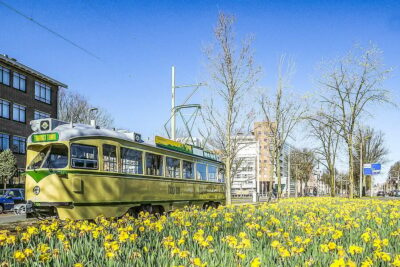
Hop-on Hop-off Old-Fashioned Heritage Tram Tour
Read our review →


Amsterdam High-End Dutch Food & History Tour – Up to 8 guests
Read our review →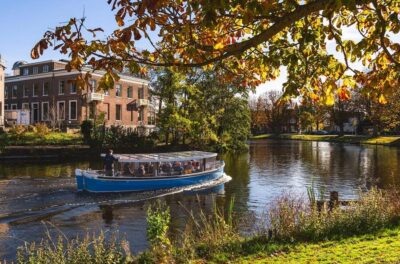
Cruise through the Historic City Center with Guide
Read our review →
Browse the lists this tour appears in