
Reviewed · WALKING TOURS
Rotterdam 2-Hour Grand Walking Tour
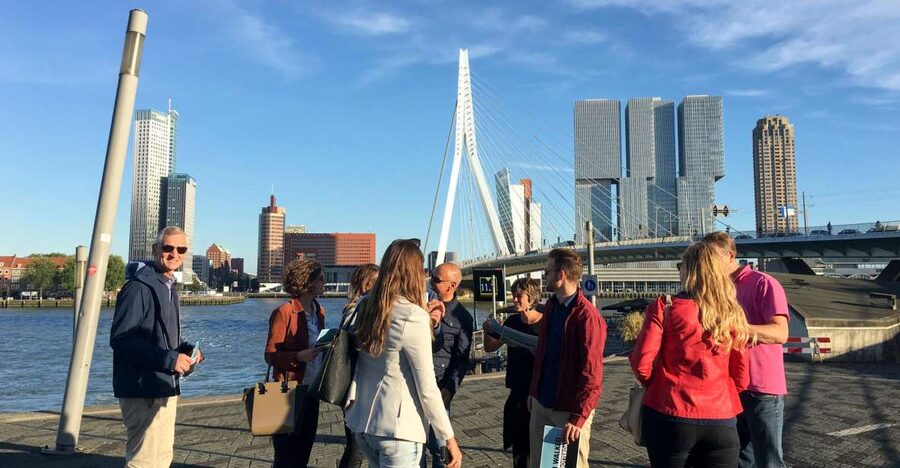
Rotterdam’s story is written in concrete, glass, and steel. This two-hour walk gives you a quick, useful introduction to the city’s wartime destruction, postwar rebuilding, and modern architectural ambition. I especially like the route through the Markthal and Cube Houses, followed by the broad river views from the Maas. I also like that the tour connects famous sights instead of treating them as isolated photo stops.
The main tradeoff is the pace. You cover about 3 to 4 kilometers in two hours, mostly outdoors, so this is a city orientation rather than a slow architectural seminar. Wear good shoes, and bring weatherproof clothing. The walk runs in rain and snow.
In This Review
- Key points at a glance
- Starting beneath Rotterdam Central Station’s new gate
- Groothandelsgebouw and the practical city rebuilt
- Lijnbaan, where shopping became part of the plan
- City Hall and the older face of Rotterdam
- Timmerhuis and Rotterdam’s forward-looking center
- Markthal, the tour’s strongest indoor stop
- Cube Houses and architecture that refuses to behave
- Along the Maas toward the South Bank
- What two hours can and cannot cover
- Price, value, and the right kind of first look
- Weather, walking, children, and access
- Who will get the most from this Rotterdam walk
- Should you book the Rotterdam Grand Walking Tour?
- FAQ
- Where does the Rotterdam Grand Walking Tour begin?
- Where does the walking tour finish?
- How long is the tour?
- How far do you walk?
- What language is the tour offered in?
- Is the tour wheelchair accessible?
- Are children allowed to join?
- Is the Markthal included?
- Are the Cube Houses included?
- Can I book a private group?
Key points at a glance
- A clear route through Rotterdam’s rebuilding story: Follow the city’s transformation from wartime loss to modern design center.
- A striking finish by the Maas: End at Boompjeskade with views toward Rotterdam’s developing South Bank.
- Markthal and Cube Houses included: See two of the city’s best-known contemporary landmarks on foot.
- A useful first-day introduction: Start at Rotterdam Central Station and finish in a central riverside area.
- Guide Tania brings a personal touch: Her tours focus on details you might otherwise walk past.
- Flexible for families and groups: Children aged 0 to 12 join free, and private group bookings are available.
Starting beneath Rotterdam Central Station’s new gate
Your walk begins outside Rotterdam Central Station, by the main entrance. This is a sensible meeting point because the station itself introduces Rotterdam’s modern character before the tour even starts.
The station is described as the city’s spectacular new gate, and it makes a strong opening image: large, recent, and designed for a city that looks ahead. From here, your guide sets the scene for Rotterdam as a port city and explains the chronology of its postwar reconstruction.
That background matters. Rotterdam can seem like a collection of bold buildings with little connection between them. The tour’s main job is to show you the connection. You learn why the center looks so different from many Dutch cities, and how the city’s present shape grew from destruction and rebuilding.
Guide Tania is named in the booking information, with one booking note spelling her name Tanya. The comments provided about her describe a punctual, friendly, and well-prepared guide who points out places that are easy to miss. That is a useful quality in Rotterdam, where a small architectural detail can be overshadowed by a much larger building nearby.
More Walking Tours in Rotterdam
- Rotterdam: Architectural Highlights Guided Walking Tour
★ 4.8 · 215 reviews - Rotterdam Walk: Hilights, Gems, Architecture & WWII | 2 or 3hrs
★ 5.0 · 149 reviews - Rotterdam: Highlights & Gems Walking Tour with Dutch Local
★ 5.0 · 133 reviews
Groothandelsgebouw and the practical city rebuilt
The route continues through central Rotterdam toward the Groothandelsgebouw. This building is one of the national monuments included on the walk, and it helps explain the city’s postwar mindset.
You are not simply shown an old building and told when it was built. The point is to understand how Rotterdam rebuilt itself as a working port and commercial center. The Groothandelsgebouw fits that story. It represents a practical city getting back on its feet, with architecture shaped by business, transport, and modern urban needs.
I like this part of the itinerary because it keeps the tour from becoming a parade of pretty facades. Rotterdam’s appeal is not mainly decorative. Its character comes from the way old functions and new design sit side by side.
The exact amount of time spent at each stop is not specified, so expect the guide to balance explanation with steady walking. If you want long periods for photography or detailed interior visits, this may feel brisk. If you want a clear framework for exploring more on your own, the pace makes sense.
Lijnbaan, where shopping became part of the plan
The Lijnbaan shopping area gives you another angle on postwar design. Rather than focusing only on monuments, the tour shows how everyday city life was planned and rebuilt.
A shopping street may sound less exciting than the Markthal or Cube Houses, but it helps you read Rotterdam as a living city. The tour links architecture with ordinary use: where people shop, move through the center, and gather.
This is one of the places where a guide can add value that a map cannot. The supplied tour details do not list every design feature or shop, so I would not book this expecting a specialist retail tour. Instead, think of the Lijnbaan as one part of a larger explanation of how Rotterdam reinvented its center after the war.
City Hall and the older face of Rotterdam
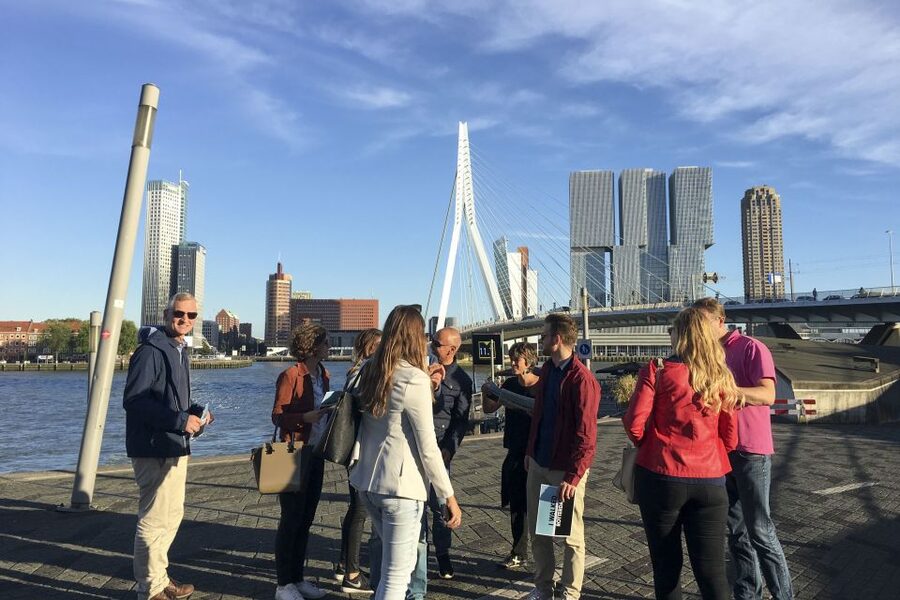
The route also reaches the neo-classical City Hall, a useful contrast to the newer buildings around it. Rotterdam is often presented as a city of daring contemporary design, but this stop reminds you that its architectural story did not begin after the war.
The contrast is the point. You see a more traditional civic style alongside the practical postwar buildings and the experimental structures that follow. The city’s identity becomes easier to understand when you can compare these periods in a short walk.
I appreciate tours that include this kind of visual comparison. You do not need a background in architecture to notice that City Hall speaks a different civic language from the Timmerhuis. The guide’s job is to explain what that difference means without turning the walk into a lecture.
Same city, a completely different afternoon:
- Rotterdam: Harbor Sightseeing Cruise
★ 4.3 · 7,599 reviews - Rotterdam: 1-Hour Sightseeing Splash Tour
★ 4.5 · 3,299 reviews - Rotterdam: Rotterdam Zoo Blijdorp Entry Ticket
★ 4.6 · 2,754 reviews - Rotterdam: Euromast Lookout Tower Ticket
★ 4.4 · 2,549 reviews
Timmerhuis and Rotterdam’s forward-looking center
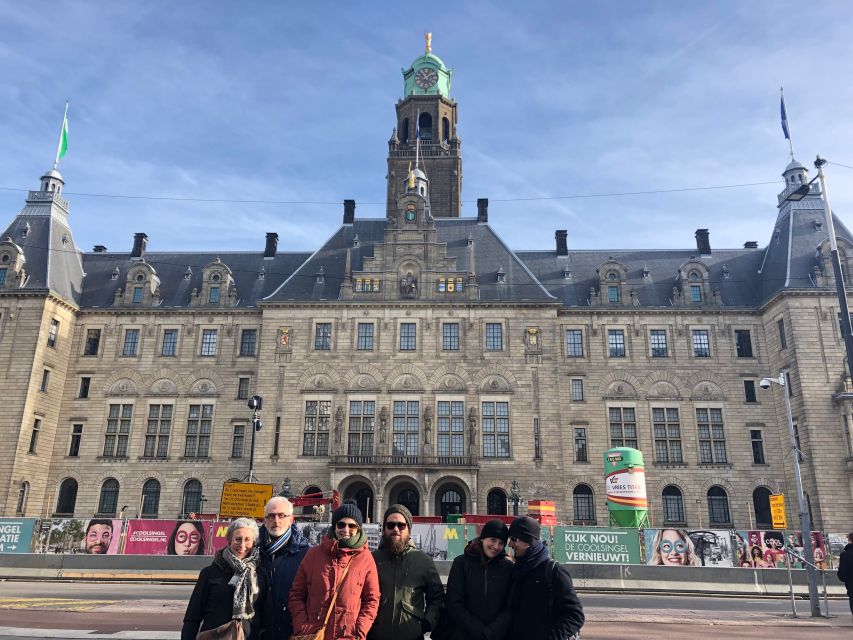
The contemporary Timmerhuis brings the tour back to the present. It represents Rotterdam’s continuing interest in new forms, new materials, and new ways of using central space.
Placed after City Hall, it works as part of a timeline. You are not seeing modern architecture at random. You are watching the city move from older civic traditions through reconstruction and into a present that still favors bold design.
The tour description calls attention to Rotterdam’s future plans as well as its past. That is important because the city is not presented as a finished museum piece. You are encouraged to see development as part of Rotterdam’s character.
For some people, this focus will be the main reason to book. For others, contemporary architecture may feel less personal than historic streets and canals. The tour is a good match if you want to know why Rotterdam looks the way it does, not if you are seeking a classic old-town walk.
Markthal, the tour’s strongest indoor stop
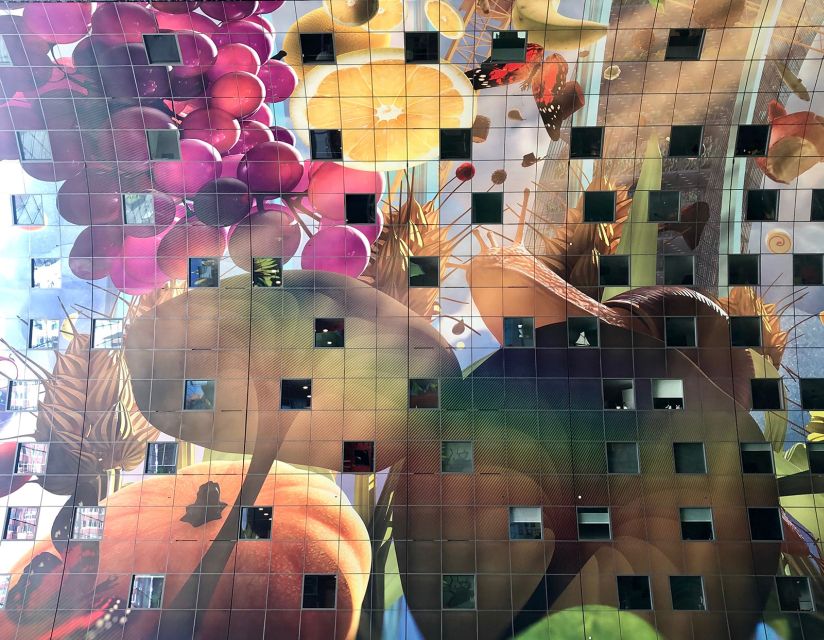
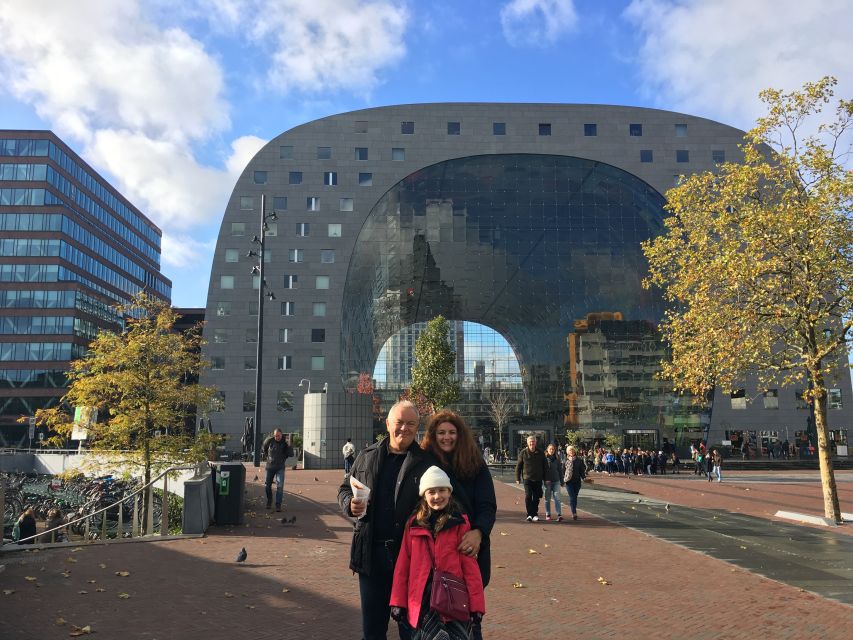
The Markthal is likely to be the visual high point of the central section. This spectacular indoor marketplace gives the walk a change of mood after the civic buildings and shopping area.
You visit the Markthal as part of the guided route, but the available details do not promise a food tasting or free time to shop. Keep that distinction in mind. You will see the marketplace and receive an introduction to it, but this is not sold as a culinary tour.
Even so, the stop has real value. The Markthal combines a public market with a major piece of modern architecture, making it one of the clearest examples of Rotterdam’s habit of putting daily life inside ambitious buildings.
I would allow yourself a little extra attention here, even if the group must keep moving. Look up, take in the scale, and notice how different the interior feels from the formal City Hall and the open streets outside. If you want to return for food or more photographs, the walking tour gives you a useful first look.
Cube Houses and architecture that refuses to behave
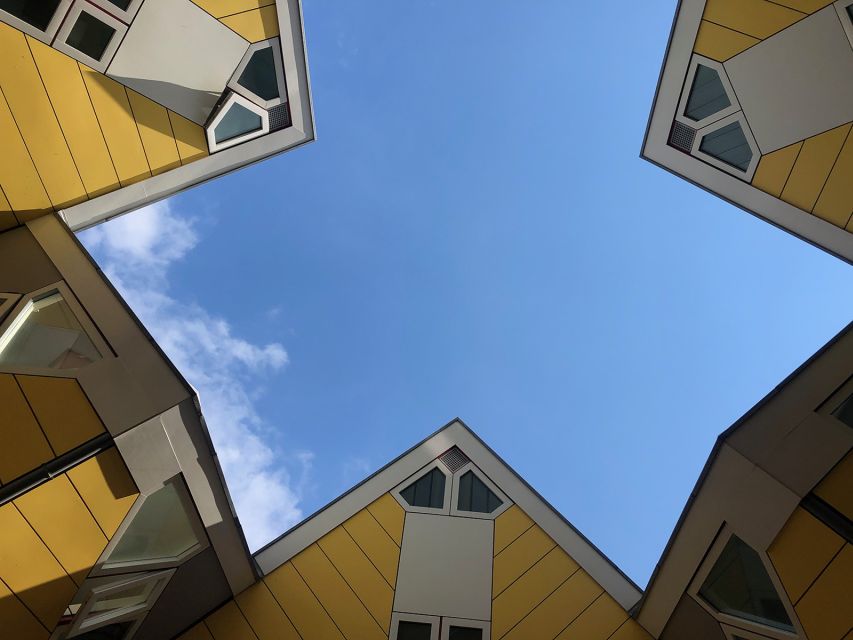
After the Markthal, the walk introduces Rotterdam’s iconic Cube Houses. These are among the city’s most recognizable buildings, and they show the playful side of its design culture.
The Cube Houses are not included simply as a quick photo opportunity. In the context of this route, they help show how far Rotterdam’s rebuilding ideas could go. The city was willing to test unusual shapes and challenge familiar ideas about what a home or neighborhood should look like.
The tour information does not promise entry into a Cube House, so expect to view the complex from the route rather than take a full interior tour. That is worth knowing if you want a detailed look inside.
Still, the stop earns its place. After hearing about commercial buildings, shopping streets, and civic architecture, you get a memorable example of design used to question normal city planning. It also gives you one of Rotterdam’s best-known images without requiring a separate visit.
Along the Maas toward the South Bank
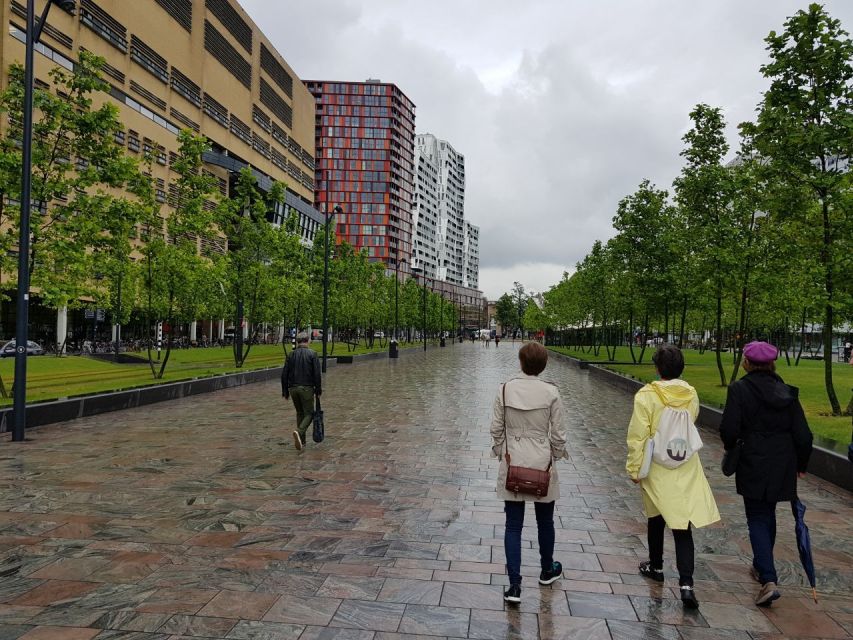
The final part of the walk leaves the center and follows the River Maas. This changes the scale of the experience. Instead of looking up at individual buildings, you get a wider view across the water toward the Head of the South, a new development on the south bank.
These river views are a strong reason to choose this particular route. Rotterdam’s port identity is easier to grasp beside the Maas than among central streets. The water opens the view and lets you see the city as a place shaped by shipping, bridges, business, and redevelopment.
The South Bank is presented as part of Rotterdam’s future. That gives the final section a useful sense of direction. The tour does not end with a building from the past. It ends by looking across the river at an area still being shaped.
The walk finishes along the riverside at Boompjeskade. This is practical for continued sightseeing, but the tour does not include transportation back to the station. You should plan your next step from the riverside rather than assume you will return to the starting point.
What two hours can and cannot cover
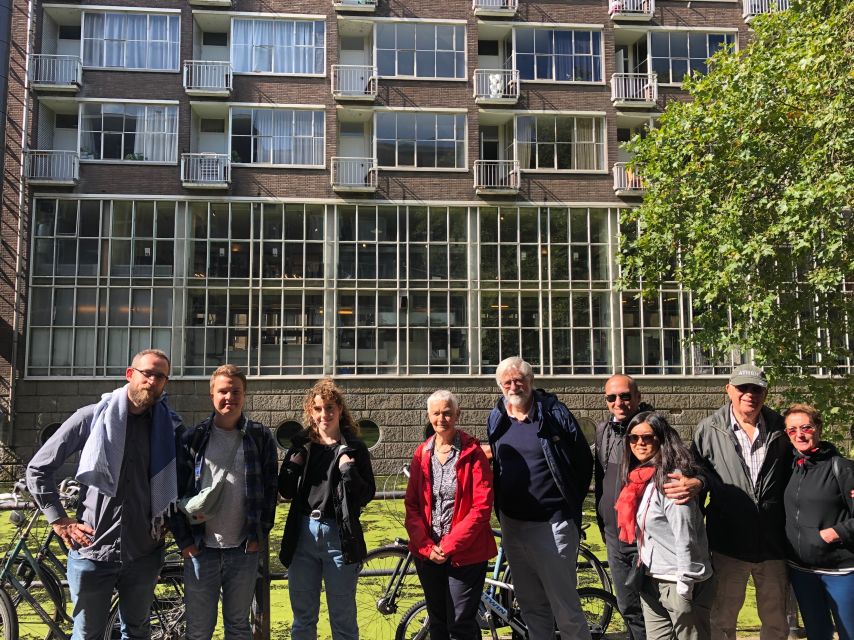
Two hours is enough to connect the major themes, but not enough to explore every stop in depth. You cover roughly 3 to 4 kilometers and move through several parts of central Rotterdam before reaching the river.
That length makes the tour useful at the start of a visit. You can learn the city’s basic layout, note buildings you want to revisit, and get a better sense of which parts deserve more time. The Italian booking note captures this benefit well: by the end, you have a clearer idea of Rotterdam’s history and identity.
The tradeoff is limited lingering time. You may not have much opportunity to browse the Markthal, enter buildings, or pause at every viewpoint. If you prefer a relaxed pace with long stops, ask about a private group option before booking. A private group may offer more control, though the supplied details do not promise a different route or duration.
Price, value, and the right kind of first look
At $53 per person, this is not the cheapest way to walk through Rotterdam. The value depends on how much structure you want.
If you explore alone, you can see several of these sights without paying for a guide. What you cannot easily reproduce is the chronological thread linking the Groothandelsgebouw, Lijnbaan, City Hall, Timmerhuis, Markthal, Cube Houses, and the Maas. You are paying for interpretation, navigation, and a focused route that fits the city’s main architectural story into two hours.
The price looks strongest for a first visit, a short stay, or anyone who finds modern architecture hard to read without context. It is also useful if you have only part of a day in Rotterdam and want to cover a lot on foot.
It is less compelling if you already know the city well, want a food-focused visit, or plan to spend most of your time inside museums and buildings. The tour is an overview, not a deep specialist study.
Weather, walking, children, and access
This tour operates in rain and snow, so clothing matters. Wear comfortable shoes and dress for the season. Rotterdam’s weather can change quickly, and a riverside finish may feel colder or windier than the sheltered city center.
The walk is listed as wheelchair accessible. Because the route covers 3 to 4 kilometers, anyone with limited stamina should consider the distance as well as the access information.
Children aged 0 to 12 can join free. Parents should think about the length, content, and pace before bringing younger children. The tour is built around architecture and city history, so it may suit older children better than very young ones, though family needs differ.
The standard tour language is English. If you need another language, contact the provider before arranging the walk. Private groups are available, which may be useful for families, friends, or groups that want a more personal format.
Who will get the most from this Rotterdam walk
I would choose this tour for a first-time visitor who wants the city explained rather than simply photographed. It suits people interested in architecture, urban change, port cities, and postwar Europe.
It also works well for visitors who have already seen Amsterdam and want a very different Dutch city. Rotterdam does not offer the same old canal-town mood. Its appeal is more direct: big structures, open water, modern rebuilding, and a clear sense that the city is still changing.
The walk may be less satisfying for someone seeking hidden lanes, museum interiors, local food, or a slow historical tour. The route has a lot of ground to cover, and its main subject is Rotterdam’s built character.
The strongest praise attached to the experience centers on the guide’s ability to point out places people would otherwise miss. That is exactly where a local walking tour earns its keep. You may pass the buildings on your own, but a guide helps you notice how they fit together.
Should you book the Rotterdam Grand Walking Tour?
Book it if you want a well-planned two-hour introduction to Rotterdam’s architecture and rebuilding story, with the Markthal, Cube Houses, and Maas included. Guide Tania is specifically identified in the booking details, and her approach is described as friendly, punctual, and clear.
Skip it if you want lots of free time, food sampling, or extended visits inside individual buildings. The 3 to 4 kilometer route is active, and the walk continues in poor weather.
For most first-time visitors, I think the route offers a sensible starting point. It gives you the city’s essential visual vocabulary, ends with strong river views, and leaves you better prepared to explore Rotterdam on your own.
FAQ
Where does the Rotterdam Grand Walking Tour begin?
It begins outside Rotterdam Central Station, by the main entrance.
Where does the walking tour finish?
The tour ends beside the River Maas at Boompjeskade.
How long is the tour?
The walking tour lasts two hours.
How far do you walk?
The route covers approximately 3 to 4 kilometers.
What language is the tour offered in?
The tour is offered in English. You can contact the provider about another language.
Is the tour wheelchair accessible?
Yes, the activity is listed as wheelchair accessible.
Are children allowed to join?
Yes. Children aged 0 to 12 can join the walking tour free of charge.
Is the Markthal included?
Yes. The route includes a visit to Rotterdam’s Markthal, the indoor marketplace.
Are the Cube Houses included?
Yes. The tour introduces Rotterdam’s iconic Cube Houses.
Can I book a private group?
Yes. A private group option is available.
More 2-Hour Experiences in Rotterdam
- Rotterdam 2-Hour Walking Tour | Discover The City With A Local
★ 4.5 · 111 reviews - Rotterdam: 2-Hour Guided Walking Tour
★ 4.6 · 58 reviews - Amsterdam: 2-Hour Canal Cruise incl. Drinks & Dutch Snacks
★ 5.0 · 594 reviews - Amsterdam 2-hour Private Canal Cruise with Live Guide and Drinks
★ 5.0 · 296 reviews
Just added around Rotterdam
- Rotterdam: Breweries and Water Taxi Tour★ 4.7 · 23 reviews
- Rotterdam: National Museum of Photography Entrance Ticket★ 3.8 · 24 reviews
- Rotterdam Highlights Private Walking Tour★ 5.0 · 26 reviews
- Private Tour: Rotterdam Walking Tour Including Harbor Cruise★ 4.5 · 27 reviews
- Rotterdam Tour with Cube House Admission★ 4.4 · 27 reviews
- Cultural Walking Tour in Rotterdam★ 5.0 · 28 reviews
- Rotterdam: Food Tour by Bike★ 4.8 · 31 reviews
- Private Customizable Day Trip From Rotterdam★ 4.5 · 31 reviews
Walking Tours, compared.
Anne Frank’s Story – Guided Walking Tour through Amsterdam
Read our review →
Life of Anne Frank and World War II Walking Tour
Read our review →
Absolutely Amsterdam – the Essential Introductory Walking Tour
Read our review →
Anne Frank Walking Tour – Guided in EN/DE/IT/ES
Read our review →
Anne Frank Walking Tour Amsterdam Including Jewish Cultural Quarter
Read our review →Browse the lists this tour appears in