
Reviewed · AMSTERDAM ARCHITECTURE TOURS
Rotterdam: Architectural Highlights Guided Walking Tour
Rotterdam’s architecture makes the most sense when you know what happened before it. This 2-hour walk follows the city from Rotterdam Centraal to the river, using buildings as clues to explain the 1940 bombing, postwar rebuilding, modern city planning, and the bold new skyline. With an architect such as Tania, Tanya, Silvia, or Sylvie leading the way, you get more than a parade of striking façades.
I like the route’s clear north-to-south story and the way it links famous stops that you can otherwise see as disconnected photo opportunities. I also like that the tour treats architecture as part of daily life, industry, and urban policy, not just as a collection of odd shapes. The main drawback is the pace: you cover 3 to 4 kilometers in two hours, so there is limited time to linger or explore side streets.
In This Review
- Key points to know before you book
- Why Rotterdam needs an architecture tour
- Meeting beneath the clock at Rotterdam Centraal
- The Lijnbaan and the postwar city
- Timmerhuis and the value of looking closely
- Sint Laurens church and the scars of 1940
- Markthal: a building you can enter
- Cube Houses and a fair warning about famous design
- The waterfront, South Bank, and Erasmus Bridge
- What the guide adds to the experience
- Price, group style, and who gets the best value
- Should you book the Rotterdam architecture walk?
- FAQ
- Where does the Rotterdam architecture tour meet?
- How long is the walking tour?
- Which Rotterdam landmarks are included?
- Is the tour conducted in English?
- Is the tour suitable for children and wheelchair users?
- What should I bring, and does the tour run in bad weather?
Key points to know before you book
- From Rotterdam Centraal to the Maas: The route gives you a useful first orientation to central Rotterdam and ends by the riverside skyline.
- An architect leads the walk: Guides explain why buildings look and function as they do, with the 1940 destruction and rebuilding at the center of the story.
- Major landmarks in one route: You pass the Lijnbaan, City Hall, Timmerhuis, Sint Laurens church, Markthal, Cube Houses, and Erasmus Bridge.
- A fast but manageable 3 to 4 km: Comfortable shoes matter, and the tour suits people who prefer steady walking to long stops.
- Strong value at $53: For two hours with a specialist guide, the price is fair, especially if architecture and urban planning interest you.
- Private groups are available: A private format may suit families or small groups who want a more flexible conversation.
Why Rotterdam needs an architecture tour
Rotterdam can feel puzzling at first. Its center does not offer one tidy historic style. Instead, you find prewar civic buildings, postwar planning, modern office blocks, experimental housing, market architecture, and new waterfront construction sharing a relatively compact area.
That mixture is the result of a sharp break in the city’s story. Rotterdam suffered major destruction during the bombing of May 1940, and much of the central area was rebuilt rather than restored. The choices made after the war still shape how the city works today.
An architect can point out the difference between simply looking at a building and reading it. You learn to ask why a street is broad, why a block is set back, why a building has a certain shape, and how a development fits into the city’s plans.
That context is the strongest reason to book this walk. Without it, the Cube Houses may look like a clever design stunt, the Markthal may seem like a colorful indoor market, and the Erasmus Bridge may be only a dramatic crossing. The guide connects those sights to wider decisions about movement, housing, commerce, public space, and Rotterdam’s future.
More Architecture Tours in Rotterdam
- Rotterdam Walk: Hilights, Gems, Architecture & WWII | 2 or 3hrs
★ 5.0 · 149 reviews - Rotterdam Architecture Highlights Walking Tour
★ 5.0 · 66 reviews - Rotterdam Must Do Tour: Highlights, History, WW2 and Architecture
★ 5.0 · 20 reviews
Meeting beneath the clock at Rotterdam Centraal
The tour begins at Rotterdam Centraal Station, underneath the clock. This is a practical meeting point because the station is easy to reach and the route immediately puts you among the city’s newer architecture.
The station itself is an important opening chapter. Its large, sharply angled form signals a modern Rotterdam and gives the guide a natural place to discuss how the city presents itself today. You start with a building designed for movement, then walk into a center shaped by reconstruction and constant change.
Expect an outdoor tour from the first minute. There is no dedicated vehicle, and transportation costs are not included because the route is walked. Bring shoes that can handle several kilometers and clothing suited to the weather.
The guide speaks English. Past guides have included Tania, Tanya, Tina, Silvia, and Sylvie, with Tania and Silvia especially praised for combining architecture with city history and urban development. Guide assignments can vary, so you should not book on the assumption that one particular person will lead your date.
The Lijnbaan and the postwar city
One of the first significant areas is the Lijnbaan, a central shopping district that helps explain postwar planning. Here the subject is not only what the buildings look like, but how the street was intended to work for everyday city life.
The Lijnbaan gives the tour a useful change of scale. Rotterdam Centraal is a major transport building, while the Lijnbaan is about pedestrians, shops, and the experience of moving through a center. Your guide can show how planning ideas after the war aimed to create a different kind of urban shopping area.
This is also where the walk begins to feel less like a sightseeing checklist. The point is not to admire one famous object, then rush to the next. Instead, you see how streets and buildings were arranged to serve particular purposes.
The route also brings in City Hall, which adds an older civic presence to the modern center. Seeing City Hall alongside later architecture helps you compare different eras and understand that Rotterdam’s identity is not entirely postwar. The city contains surviving reminders of its earlier civic life, even as much of the core was remade.
Timmerhuis and the value of looking closely
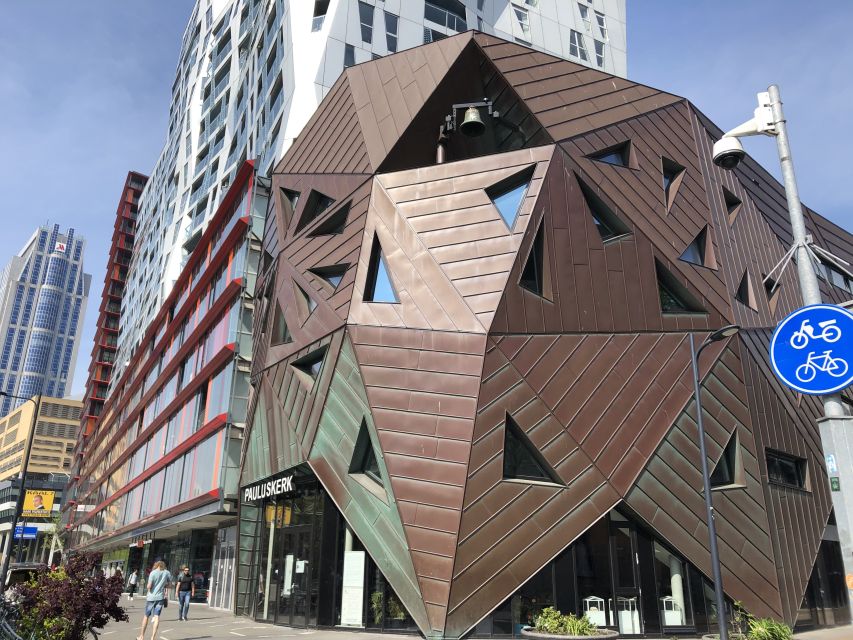
The Timmerhuis is one of the tour’s more contemporary stops. Its design gives the guide a chance to explain current ideas about offices, mixed use, flexibility, and the relationship between a new building and the surrounding city.
This is the kind of place where an architect’s training can make a real difference. You may notice the overall form on your own, but the guide directs your attention to how parts fit together and what the building is meant to do.
The tour’s strongest guides use plain explanations rather than assuming that you already understand design terms. That makes the walk suitable even if your interest is simply curiosity about Rotterdam. You do not need an architecture background to follow the discussion.
One practical limitation is that the two-hour schedule leaves little room for long technical discussions. If a building catches your interest, you may have to save your questions for the walk between stops. Several past participants wished the tour lasted longer, with some saying they would have preferred four hours.
More Sightseeing Tours in Rotterdam
- Rotterdam: Harbor Sightseeing Cruise
★ 4.3 · 7,599 reviews - Rotterdam: 1-Hour Sightseeing Splash Tour
★ 4.5 · 3,299 reviews - Rotterdam: 2.5-Hour Highlights Bike Tour
★ 4.7 · 399 reviews - Rotterdam: RIB Speedboat Sightseeing Cruise
★ 4.8 · 192 reviews
Sint Laurens church and the scars of 1940
The Sint Laurens church provides an important contrast. It is a surviving historic structure in a city center known for modern design, so it helps you picture what was lost and what remained.
The guide uses the church and its surroundings to explain the impact of wartime destruction and the choices made during rebuilding. This is one of the most useful parts of the tour because it gives emotional and historical weight to Rotterdam’s modern center. The new buildings are not simply bold for the sake of being bold. They grew from a city forced to make difficult decisions quickly.
Look around as you walk. The gaps between old and new, the open spaces, and the changes in street scale all become easier to read after this explanation. One especially memorable detail described by a past guide is lighting embedded in sidewalks that outlines the part of the city destroyed by bombing. If it is included in your route, it offers a quiet reminder beneath the modern streets.
The discussion stays focused on architecture, but it also touches daily life and the industrial past of Rotterdam. That wider view keeps the tour from becoming a narrow design lecture.
Markthal: a building you can enter
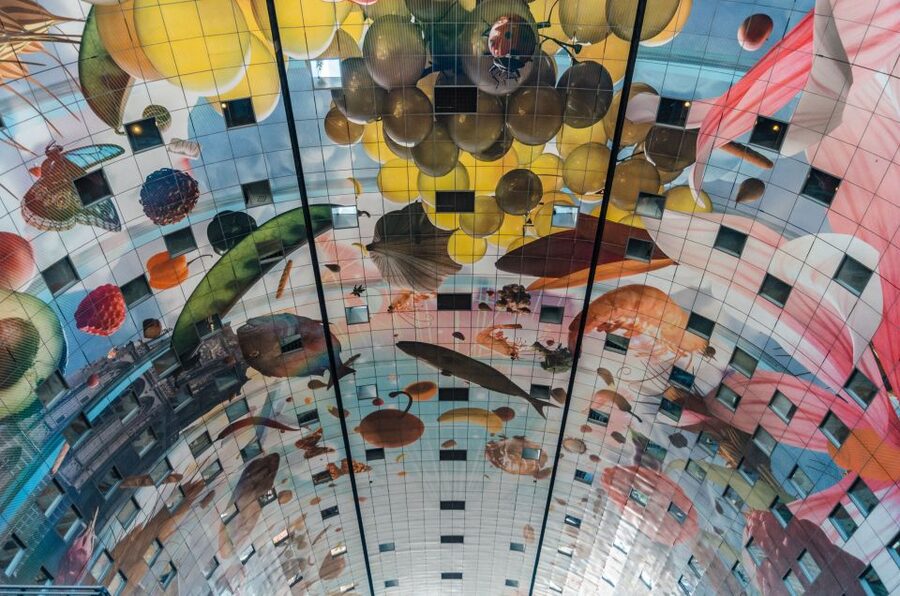
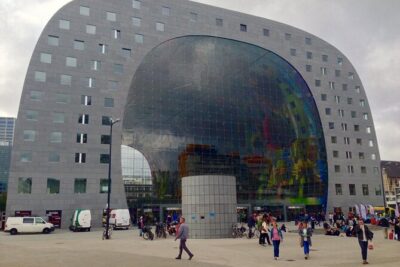
The Markthal is one of the route’s most enjoyable stops because you go inside rather than viewing it only from the pavement. The building combines a market function with a large architectural form, making it easy to discuss both public use and visual impact.
Inside, take time to look up and around. The space gives you a sense of how architecture can turn an everyday activity into a major public experience. Your guide explains the building as part of Rotterdam’s newer development, then gives you a chance to see its scale from within.
The Markthal is also a good pause point in a walk that otherwise keeps moving. It offers shelter from a short spell of rain, although the tour operates rain or shine and you should still dress for outdoor conditions.
Do not expect a food tour. Food and drinks are not included, and the focus remains on the building and its place in the city. If you want to browse or eat, you may need to return later, since the group continues along the planned route.
Cube Houses and a fair warning about famous design
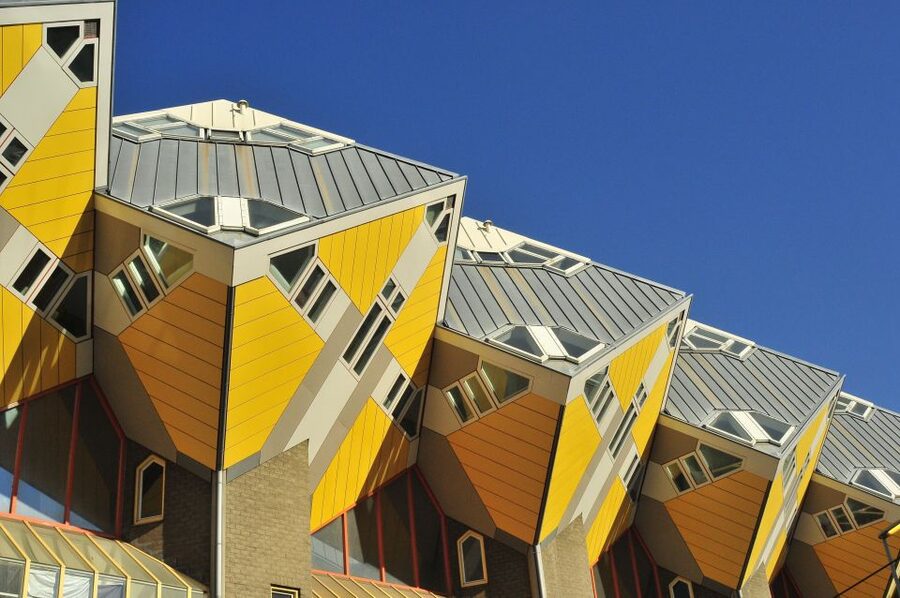
From the Markthal, the walk passes the row of Cube Houses. They are among Rotterdam’s best-known architectural sights, and the guide explains the ideas behind their unusual angles and compact arrangement.
This is a good example of why interpretation helps. The houses are immediately photogenic, but their value lies in the questions they raise about how a home can be arranged, how residents use unusual interiors, and how a city decides to make housing part of its public image.
You should also approach this stop with an open mind. One past participant felt the Cube Houses were overpraised and would have preferred more attention to social housing projects. That criticism points to a real limit in a highlights-focused route: famous experimental buildings receive attention, while less celebrated housing may remain outside the itinerary.
If your main interest is Rotterdam’s social housing, neighborhood planning, or ordinary residential districts, this may not be the perfect tour. If you want to understand the city’s best-known central designs, the Cube Houses belong on the route, even if you decide their success is debatable.
The waterfront, South Bank, and Erasmus Bridge
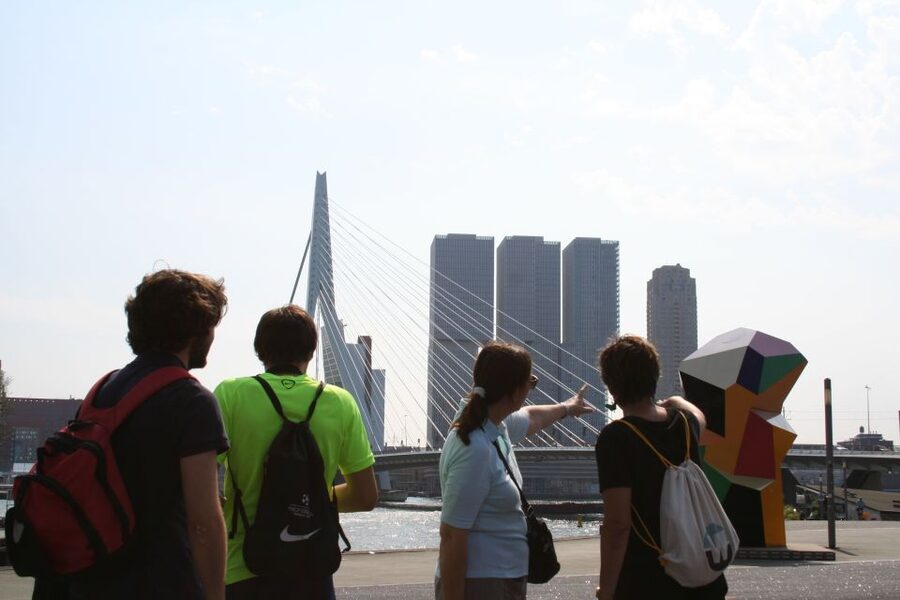
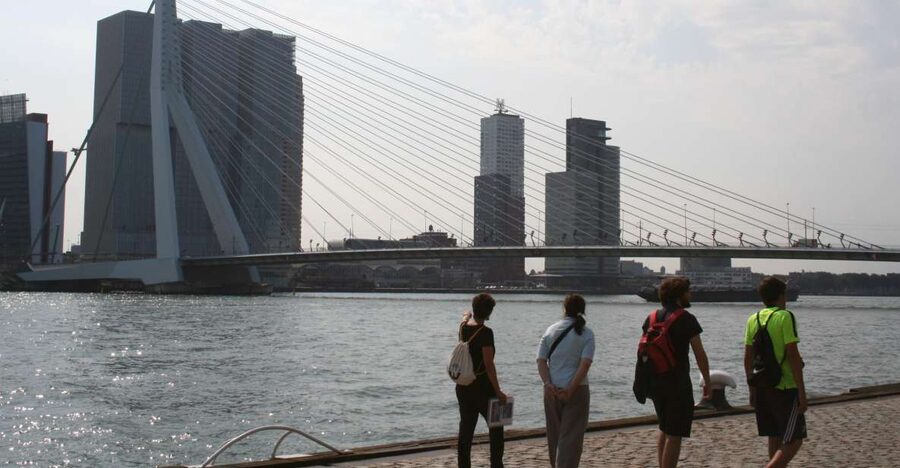
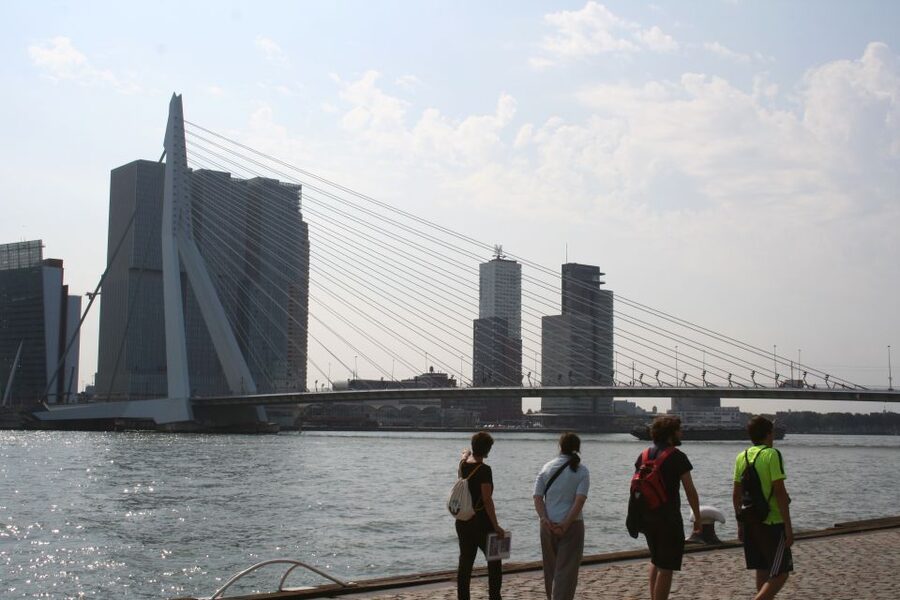
The walk finishes near the river, where Rotterdam’s newer development comes into view. From here, you can look toward the South Bank and the high-rise skyline, with the Erasmus Bridge as the visual centerpiece.
This ending works well because it brings the tour from the station’s land-based transport hub to the water and the city’s international face. Rotterdam’s industrial and port identity becomes part of the story, while the newer waterfront shows how the city continues to plan for growth and change.
The Erasmus Bridge is a fitting final landmark. Its shape is easy to recognize, but the guide gives you a better sense of how it connects the two sides of the city and fits into the developing riverfront. You finish with a broad view of Rotterdam rather than returning to the station, so plan your next activity from the waterfront area.
The route’s one-way design is useful for sightseeing, but it also means you should think about timing. If you have a train to catch at Rotterdam Centraal immediately afterward, allow extra time to return. The tour ends by the riverside, not at the original meeting point.
What the guide adds to the experience
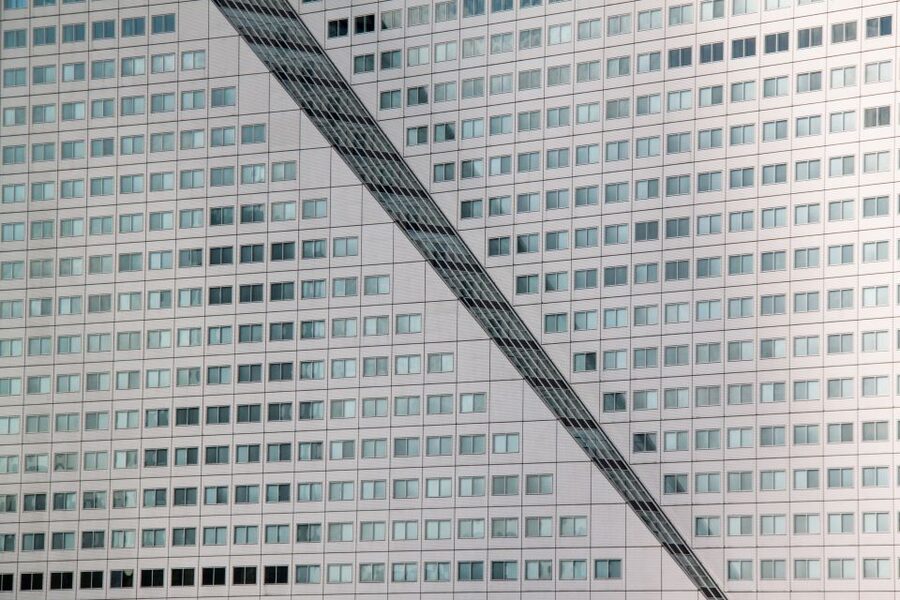
The best part of this tour is the guide’s way of joining facts into a story. Past guides such as Silvia and Sylvie have been praised for explaining the city’s architectural development in its historical setting, while Tania has been praised for making the walk friendly, clear, and lively.
You can expect discussion of:
- Rotterdam’s industrial past and daily life
- The bombing and postwar rebuilding
- Different architectural styles in the center
- Urbanization and long-term city planning
- The way buildings serve public, commercial, residential, and civic purposes
- New development along the river and South Bank
The walk is aimed at a general audience. You do not need specialist knowledge, and the explanations are adjusted to people with little or no architecture background. Guides have also answered questions and offered suggestions for other sights, restaurants, and things to do in Rotterdam.
Pacing can vary. Some participants praised the steady rhythm, including guides who paused for slower walkers. Others wanted more pauses. If you walk slowly, have small children, or want time for photographs, a private group may give you a better chance to shape the pace.
Price, group style, and who gets the best value
At $53 per person, this is not the cheapest way to see Rotterdam’s center, but it is a fair price for a 2-hour walk led by an architect. You are paying for interpretation, not transportation, food, or entry tickets.
I consider it especially good value at the start of a Rotterdam visit. The route covers many central sights in one stretch, and the explanations can change how you see the rest of the city. A casual walk may show you the same buildings, but it is unlikely to explain their links to wartime destruction, urban planning, and future development.
The tour suits you best if you:
- Like architecture, design, or city planning
- Want a strong first orientation to central Rotterdam
- Prefer walking to a bus or boat tour
- Enjoy historical context with your sightseeing
- Can comfortably walk 3 to 4 kilometers
- Want to ask questions of a specialist guide
It is less suitable if you want a relaxed photo walk with long stops, a food-focused outing, or a tour centered on social housing and outer neighborhoods. Families can bring children aged 0 to 12 for free, but parents should consider the distance, subject matter, and two-hour duration.
The tour is wheelchair accessible, though you may still want to confirm that the route and pace suit your group’s needs. It runs rain or shine, so a waterproof layer is sensible in Rotterdam.
Should you book the Rotterdam architecture walk?
Book it if you want Rotterdam to make sense, not just look unusual. The route gives you a brisk but useful introduction to the city’s rebuilding, its mix of styles, and its ongoing riverfront plans.
I would book this early in a stay, when the information can guide your later wandering. Choose it with realistic expectations: you will cover ground, see many highlights, and gain a strong framework, but you will not study every building or explore the city’s residential projects in depth.
For $53, the architect-led format offers better context than sightseeing alone. If you prefer more time for questions, have a small private group, or are especially interested in architecture, the private option may be worth considering. Otherwise, the standard 2-hour walk is a smart introduction to Rotterdam’s central design story.
FAQ
Where does the Rotterdam architecture tour meet?
Meet your English-speaking guide at Rotterdam Centraal Station, underneath the clock.
How long is the walking tour?
The tour lasts 2 hours and covers approximately 3 to 4 kilometers.
Which Rotterdam landmarks are included?
The route includes Rotterdam Centraal, the Lijnbaan, City Hall, Timmerhuis, Sint Laurens church, Markthal, the Cube Houses, the riverside developments, South Bank views, and Erasmus Bridge.
Is the tour conducted in English?
Yes. The live guide conducts the tour in English.
Is the tour suitable for children and wheelchair users?
The tour is wheelchair accessible. Children aged 0 to 12 can join for free, but parents should consider the walking distance, content, and two-hour duration.
What should I bring, and does the tour run in bad weather?
Bring comfortable shoes and weather-appropriate clothing. The tour operates rain or shine.
More Architecture Walks in Rotterdam
- Amsterdam: Canal House Museum ‘Willet-Holthuysen’ Ticket
★ 4.3 · 194 reviews - The rise of Haarlem: Culture, History, Art and Architecture Walking Tour
★ 5.0 · 59 reviews - Learn to Make Dutch Pancakes in a Beautiful Amsterdam Canal House
★ 4.5 · 47 reviews - Amsterdam: Craft Dutch Pancakes in Charming Canal House
★ 4.6 · 41 reviews
More Walking Tours in Rotterdam
- Rotterdam: Highlights & Gems Walking Tour with Dutch Local
★ 5.0 · 133 reviews - Rotterdam 2-Hour Walking Tour | Discover The City With A Local
★ 4.5 · 111 reviews - Walking Rotterdam Food Tour
★ 5.0 · 89 reviews - Rotterdam: City Center Walking Tour
★ 4.5 · 88 reviews
Just added around Rotterdam
- Rotterdam: Breweries and Water Taxi Tour★ 4.7 · 23 reviews
- Rotterdam: National Museum of Photography Entrance Ticket★ 3.8 · 24 reviews
- Rotterdam Highlights Private Walking Tour★ 5.0 · 26 reviews
- Private Tour: Rotterdam Walking Tour Including Harbor Cruise★ 4.5 · 27 reviews
- Rotterdam Tour with Cube House Admission★ 4.4 · 27 reviews
- Cultural Walking Tour in Rotterdam★ 5.0 · 28 reviews
- Rotterdam: Food Tour by Bike★ 4.8 · 31 reviews
- Private Customizable Day Trip From Rotterdam★ 4.5 · 31 reviews
Amsterdam Architecture Tours, compared.
Rotterdam Walk: Hilights, Gems, Architecture & WWII | 2 or 3hrs
Read our review →
The rise of Haarlem: Culture, History, Art and Architecture Walking Tour
Read our review →
Learn to Make Dutch Pancakes in a Beautiful Amsterdam Canal House
Read our review →
Rotterdam Must Do Tour: Highlights, History, WW2 and Architecture
Read our review →Browse the lists this tour appears in