
Reviewed · WALKING TOURS
Utrecht Private Walking Tour With A Professional Guide
Utrecht’s story unfolds one street at a time on this private walk. From Neude Square, you’ll trace the city’s Roman roots, see the Dom Tower and Domkerk, and follow the Oudegracht, where the canal sits below street level. The guide turns familiar sights into a connected story, rather than a string of photo stops.
I like the one-group format, which lets you ask questions and set the pace. I also like the range of subjects, from Traiectum and early Christianity to Nazi rule, liberation, and modern rebuilding. The main drawback is the price: $313 for up to 15 people is fair for a full group, but expensive for one or two people, and entrance fees are not included.
In This Review
- Key points to know
- Starting at Neude Square
- From Roman Traiectum to a Christian center
- The Dom Tower and Domkerk
- Utrecht’s churches beyond the Dom
- Walking beside the Oudegracht
- City hall, Oudaen, and Voorstraat
- From independence to the Republic
- Industry, war, and modern rebuilding
- What the private format is really worth
- The guides and the tone of the walk
- Who should book this Utrecht walk?
- Should you book the Utrecht Private Walking Tour?
- FAQ
- Where does the Utrecht walking tour start?
- Where does the tour finish?
- How long does the tour last?
- Is the tour private?
- Is the tour offered in English?
- Are entrance fees included?
- What is the cancellation policy?
Key points to know
- Roman beginnings: Learn how Traiectum helped give Utrecht its name and place in the Roman world.
- Major landmarks in two hours: See the Dom Tower, Domkerk, city hall, Neude Square, Oudegracht, and several historic churches.
- A private guide throughout: Your group is on its own, with no strangers joining the walk.
- Guides with local personality: Willemijn, Giovanna, and Famke have all led walks praised for clear explanations, warmth, and good conversation.
- A flexible route: The guide may adjust the walk on the spot to suit your interests.
- Simple central meeting point: Begin and end at Neude, close to public transportation.
Starting at Neude Square
Neude is a practical place to begin. It is central, easy to reach by public transportation, and gives you an immediate sense of Utrecht as a living city rather than a museum display. The walk begins and ends here, so you can continue exploring afterward without having to find your way back across town.
Your guide uses the square as a doorway into Utrecht’s past. The city’s story reaches back to the Roman period, when a settlement called Traiectum occupied an important position. That name is tied to a crossing, and it helps explain the origin of Utrecht.
This early history matters because Utrecht’s location shaped everything that followed. The city became a religious center for the northern part of the Netherlands and also grew as a place of trade. You are not simply hearing dates. You are learning why this particular spot became important.
The private format is useful right away. You can ask your guide to explain a point more fully, or move along if a subject is less interesting to your group. On a standard group walk, you often have to accept the guide’s pace. Here, the conversation can be more personal.
More Private Tours in Utrecht
- Private Walking Tour in Utrecht
★ 4.5 · 14 reviews - Private Utrecht Food Walking Tour with 8 Tastings
★ 5.0 · 12 reviews - Private tour: Your Own Utrecht – mysteries and treasures
★ 5.0 · 9 reviews
From Roman Traiectum to a Christian center
The first part of the story covers Roman rule, later Germanic invasions, and the Carolingian Empire. That is a lot of ground for a two-hour tour, so expect a clear overview rather than a specialist lecture.
The value is in seeing how Utrecht changed hands and purpose over time. Roman foundations, Germanic pressure, and Carolingian power all helped shape the city before its church buildings and trade routes gave it wider influence.
Utrecht became an important center of Christianity in the north. As you walk between churches, your guide explains how religion helped shape the city’s buildings, institutions, and position in the region.
This part of the route is especially good for you if you want context before looking at architecture. A church can be attractive on its own, but it becomes more interesting when you understand why so many religious buildings appeared here and how they influenced Utrecht’s growth.
The Dom Tower and Domkerk
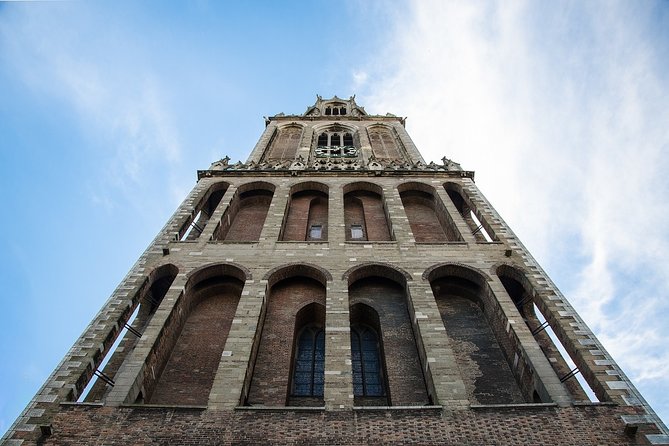
The Dom Tower is the most recognizable sight on the walk. Even without entering, it gives you a strong visual anchor for the old center. Your guide connects the tower to the wider story of Utrecht’s religious importance and the long development of the city around it.
The Domkerk, or Dom Church, adds a different layer. The church and tower are closely associated, but seeing them as part of the same historic center helps you understand the scale and importance of the medieval religious complex.
One practical point matters here: entrance fees are not included. The route includes the sights from the outside, while access inside a church or other site may require a separate payment. A past guest particularly enjoyed entering the cathedral, but you should confirm current access and fees with your guide or at the site.
Do not expect a tower climb to be part of the two-hour walk. The supplied details promise the Dom Tower and Domkerk as sights, not a tower admission or ascent. If climbing the tower is a priority, ask before booking or contact the operator about adding it separately.
Utrecht’s churches beyond the Dom
The walk also passes the Sint-Catharinakathedraal, Sint-Willibrordkerk, and Janskerk. Together, these buildings show that Utrecht’s religious story is not confined to one famous landmark.
The Sint-Catharinakathedraal gives the route another major church to compare with the Domkerk. The Sint-Willibrordkerk and Janskerk add further examples of Utrecht’s church architecture and its long connection with Christianity.
I like this part of the route because it stops the Dom from becoming the whole story. You get a broader picture of the city’s religious quarter and see how different buildings contribute to Utrecht’s identity.
The Oude Hortus is another named stop. The details provided do not specify what portion of the site you enter or whether admission is included, so treat it as a place your guide will show and explain rather than assume a full visit inside.
More Walking Tours in Utrecht
- Utrecht 2-Hour Walking Tour | Discover The City With A Local
★ 5.0 · 138 reviews - Utrecht: Guided Highlights Walking Tour
★ 4.7 · 80 reviews - Utrecht Old Town: Medieval Monster Hunt & Walking Tour
★ 4.0 · 62 reviews - Utrecht Walking Tour with a local comedian as guide
★ 5.0 · 48 reviews
Walking beside the Oudegracht
The Oudegracht is the most atmospheric stretch of the walk. Utrecht’s main canal is famous for its lower-level wharves and water-side spaces, which give the route a different feel from an ordinary street beside a canal.
Your guide explains the canal as part of Utrecht’s trading past. This is where the city’s role as a commercial hub becomes easier to picture. The waterway was not just decorative. It helped connect the city’s people, goods, and working life.
The canal also gives you a welcome visual break from church history. You move from towers and religious buildings to water, bridges, old facades, and the practical side of urban life.
The route is described as a leisurely walk, and one past guest spent more than two hours with the guide. The official duration is approximately two hours, so allow a little flexibility if your group asks questions or pauses often. Comfortable shoes are sensible, since the experience is entirely on foot.
City hall, Oudaen, and Voorstraat
The Stadhuis van Utrecht, or city hall, brings politics and civic life into the story. After hearing about Roman occupation, religion, and trade, you see how Utrecht functioned as a city governed by its own institutions.
Oudaen adds another historic building to the route. The supplied information does not give a detailed description of its interior or current use, so the guide’s explanation is likely to be the main reason for including it.
Voorstraat offers a change of scene from the monument-heavy center. It helps you see Utrecht as a city of connected streets rather than a short line of famous buildings. The guide can point out details you might pass without noticing alone.
This is where a private tour earns its keep. If you are curious about one building, street, or period, you can ask for more detail. If your group prefers a brisk overview, you can keep moving.
From independence to the Republic
The historical account then moves into the 16th century, when Utrecht’s independence came to an end. The city’s political position changed as the Netherlands moved toward the Republic of the Netherlands.
This transition is important because Utrecht’s story is not only medieval. The city had to adapt as political power shifted and the old order gave way to a new national structure.
A two-hour walk cannot explain every conflict or political detail. Instead, you get a useful framework for understanding why the city’s role changed over time. If political history is your main interest, use the private setting to ask your guide for more detail.
Industry, war, and modern rebuilding
The final historical subjects bring the tour into the industrial age, World War II, and the present. You hear about wartime bombing, Nazi control, liberation, and the reconstruction that followed.
This modern section gives the walk needed balance. Utrecht is not presented as a perfectly preserved old town untouched by events. It experienced destruction, occupation, liberation, and the difficult work of rebuilding.
The inclusion of Nazi rule and liberation is valuable because it places the streets you see in living memory, not only in the distant past. The discussion of modern reconstruction then explains how today’s Utrecht developed after the war.
The provided details call out a World War II blitz. The guide can explain how that affected the city, but the exact buildings or sites used for this part of the story are not specified. You should expect an interpretive account during the walk rather than a dedicated war museum visit.
What the private format is really worth
The tour costs $313 per group of up to 15 people. That price makes the most sense when shared by a family, group of friends, or organized party. At the full limit, the cost works out to about $21 per person. For two people, it is about $156.50 each, so the value calculation changes sharply.
You are paying for a guide who stays with your group only, not for admissions or transport. The strongest benefit is conversation: you can ask questions, request more time at a sight, and possibly customize the route during the walk.
The duration is about two hours. That is long enough for a city orientation and a solid historical overview, but not long enough for every church interior or museum. Think of it as a smart introduction to Utrecht, not a full-day study of the city.
The average booking lead time is 129 days. That suggests you should not leave this until the last minute if your schedule is fixed, especially if you want a particular date or guide. Confirmation is issued at booking, and free cancellation is available up to 24 hours before the start time. Changes or cancellations inside that window are not accepted for a refund.
The guides and the tone of the walk
The strongest praise centers on the guides’ explanations, patience, friendliness, and personal connection with Utrecht. Willemijn has led a relaxed walk that began at the train station, although the stated meeting point for this experience is Neude. Giovanna has been described as easy to talk with and full of useful information, while Famke has guided a particularly well-liked visit through the historic center.
These names do not guarantee who will lead your tour. They do show the kind of experience to expect: a local guide who can explain the city in a conversational way, not simply recite a fixed script.
One past guest appreciated learning about places they might otherwise have passed while seeing only the obvious tourist sights. That is the key advantage here. You get a framework for the city and small pieces of local context that are easy to miss when walking alone.
The tone also appears suited to mixed groups. A patient guide with a sense of humor can keep a history-heavy walk from becoming dry. Still, your experience will depend on the guide assigned and on how actively your group joins the conversation.
Who should book this Utrecht walk?
I would choose this tour if you have only a short time in Utrecht and want to understand the city before exploring on your own. It is also a good first activity for a private group that wants help finding its bearings without joining a large public tour.
History fans will appreciate the wide timeline, from Rome and the Carolingian Empire to industrialization and World War II. Architecture lovers will enjoy the sequence of churches, the Dom complex, city hall, Oudaen, and the canal-side streets.
Families and older visitors may like the private pace, since the guide can adjust for the group. Service animals are allowed, the route is near public transportation, and most people can take part. The supplied details do not describe step-free access, exact walking distances, or restroom stops, so ask ahead if those points matter to you.
You may want another option if you need extensive interior visits, a tower climb, or a low-cost experience for a couple. Since admission is not included and the walk lasts only about two hours, the price is harder to justify for a small party unless personal guiding is a priority.
Should you book the Utrecht Private Walking Tour?
Book it if you value a local guide, want Utrecht’s history explained in one clear route, and can share the $313 group price. The mix of Roman origins, churches, Oudegracht, civic buildings, trade, war, and reconstruction gives you much more than a quick landmark checklist.
Before booking, confirm the meeting details, ask which guide is scheduled, and check if entering the Domkerk or another church is possible at an extra cost. For a group of several people, this is a practical and personable way to get oriented. For one or two people, compare the total price carefully against other guided options.
FAQ
Where does the Utrecht walking tour start?
The tour starts at Neude, 3512 Utrecht, Netherlands.
Where does the tour finish?
The activity ends back at the meeting point at Neude.
How long does the tour last?
The tour lasts approximately two hours. A past walk lasted more than two hours, so allow some flexibility if your group stops often or asks extra questions.
Is the tour private?
Yes. A local guide accompanies only your group, and the group can include up to 15 people.
Is the tour offered in English?
Yes. English is the listed language for the experience.
Are entrance fees included?
No. Entrance fees are not included in the price.
What is the cancellation policy?
You can cancel up to 24 hours before the experience start time for a full refund. Cancellations or changes made less than 24 hours before the start time are not accepted for a refund.
Just added around Utrecht
- Utrecht Food Tour on a Bicycle with local guide★ 5.0 · 23 reviews
- e-Scavenger hunt Utrecht: Explore the city at your own pace★ 4.5 · 28 reviews
- Utrecht Quiz Tour★ 3.2 · 31 reviews
- Discover Our Utrecht: Limited Group Size & Optional Extras★ 5.0 · 32 reviews
- Utrecht: Lofen Palace with Entry Ticket & Guide (Dutch)★ 4.4 · 41 reviews
- From Amsterdam: Castle De Haar Guided Tour★ 4.7 · 41 reviews
- Utrecht: Ludwig’s Original Pub Crawl with VIP Club Entry★ 3.3 · 42 reviews
- Utrecht: Museum Speelklok Entry Ticket★ 4.5 · 48 reviews
Walking Tours, compared.
Anne Frank’s Story – Guided Walking Tour through Amsterdam
Read our review →
Life of Anne Frank and World War II Walking Tour
Read our review →
Absolutely Amsterdam – the Essential Introductory Walking Tour
Read our review →

Anne Frank Walking Tour – Guided in EN/DE/IT/ES
Read our review →
Anne Frank Walking Tour Amsterdam Including Jewish Cultural Quarter
Read our review →Browse the lists this tour appears in