

Reviewed · HISTORICAL TOURS
Amsterdam: Private Pedicab Historical Sightseeing Tour
Amsterdam’s best views often come from streets too narrow or awkward for a car. This private pedicab tour slips through the old centre, canal ring, Jewish Quarter, Chinatown, and Museumplein while Bram de Haan explains what you are seeing. It is an easy way to get your bearings without spending two hours on foot.
I like the personal scale, with room for only two passengers, and the fact that Bram uses maps and photographs to make the city’s past easier to follow. I also like the hotel pickup and warm blanket offered in cold weather. The main drawback is the 200-kilogram combined passenger limit, with no passenger over 100 kilograms, so check the restrictions before booking.
In This Review
- Key points at a glance
- Why a pedicab works well in Amsterdam
- Dam Square, where Amsterdam begins
- Zeedijk and the edge of Chinatown
- New Market and the medieval city gate
- Montelbaanstoren and the Oude Waal
- The Jewish Quarter and Amsterdam’s wartime memory
- The Hermitage and the Skinny Bridge
- The 17th-century canal ring
- Museumplein and the Rijksmuseum tunnel
- What the two-hour schedule really gives you
- Comfort, access, and practical limits
- Who should book this Amsterdam pedicab tour?
- Should you book it?
- FAQ
- How long is the Amsterdam pedicab tour?
- How many people can join the private tour?
- What languages does the guide speak?
- Is hotel pickup included?
- Where does the tour begin?
- What places will I see?
- Is food included?
- Is the pedicab suitable for everyone?
Key points at a glance

- Dam Square to Museumplein: Cover Amsterdam’s central sights in one continuous two-hour ride.
- A real local guide: Bram de Haan provides explanations in English, Dutch, or German, with maps and photographs to add context.
- Small lanes, large views: The pedicab can reach streets and corners that are difficult for cars.
- Serious history included: See the Portuguese Synagogue, Holocaust Names Monument, old defenses, and Jewish Quarter.
- Useful for limited walking: You can see a great deal while seated, though this is not a wheelchair tour.
- Flexible ending: You can arrange a preferred drop-off point before the tour begins.
Why a pedicab works well in Amsterdam
A standard walking tour gives you close contact with the city, but Amsterdam spreads its sights across several districts. A boat tour shows off the waterways, yet it cannot reach Dam Square, the Jewish Quarter, or Museumplein. The pedicab fills the gap: you sit above street level, move at a gentle pace, and cover more ground than you would on foot.
The private format matters. You are not sharing the ride with a large group, so you can ask questions and request a short pause for photographs. The schedule is built around two passengers, which makes this a good choice for a couple, two friends, or a parent traveling with one older child.
You should not expect a fast transport service. The point is to look around, listen, and get a broad picture of Amsterdam. Traffic, narrow streets, and the need to explain each place mean that some stops are brief. If you want long visits inside museums or extended time at every monument, you need a separate plan.
Bram’s approach also suits travelers who like context. He has used photographs and maps to show how Amsterdam grew and changed, including the city’s development from its early beginnings through the Second World War. That extra visual material can help you understand why the canals curve as they do and why the canal houses look similar but not identical.
More History Tours in Amsterdam
- Amsterdam Food and Cultural Tour with Tastings
★ 5.0 · 2,442 reviews - Amsterdam: Haunted History and Ghost Walking Tour
★ 4.5 · 488 reviews - Amsterdam High-End Dutch Food & History Tour – Up to 8 guests
★ 5.0 · 482 reviews
Dam Square, where Amsterdam begins
The tour starts at Dam Square, the symbolic heart of the old centre. This is where Amsterdam began to grow, and the square still brings together several major landmarks: the Royal Palace, the New Church, and the National Monument.
It is a busy place, but that is part of its value as an opening stop. You immediately see how Amsterdam combines royal power, religious buildings, national memory, and daily city life in one central space.
Bram’s explanation here helps you read the square rather than simply photograph it. If this is your first visit, Dam Square gives you a useful starting point for the rest of the ride. You can then recognize how the city expanded outward from this core.
Zeedijk and the edge of Chinatown
From Dam Square, you continue to Zeedijk. The name recalls the street’s earlier role as a sea dike, part of the defenses that protected the old settlement. Today it is a city street, but its name preserves a clue about Amsterdam’s relationship with water.
You’ll see the oldest café still standing with its original interior. The tour also gives you a glimpse of nearby Chinatown. This is a short stop, not a food tour, so do not book expecting tastings or a meal. Food and drinks are not included.
I like this section because it links ordinary street life with Amsterdam’s early struggle to hold back the water. It also shows how quickly the city’s character can change from old Dutch buildings to the signs and businesses of Chinatown.
New Market and the medieval city gate
The next stop is New Market Square, or Nieuwmarkt, with its 15th-century city gate in the middle. This building is one of the clearest reminders that Amsterdam was once a fortified town rather than the broad canal city you see today.
The square is a useful place to pause because the old gate gives the surrounding area a strong sense of scale. Bram explains the role of the gate and the history tied to the square, helping you see the old centre as a working defensive settlement.
The ride does not include a formal interior visit here. You are seeing the building and hearing its story from outside, so plan another visit if you want more time for photographs or a closer look.
More Private Tours in Amsterdam
- Rijksmuseum Amsterdam Small-Group Tour with Private Upgrade
★ 4.5 · 1,547 reviews - Van Gogh Museum Tour Reserved Entry Semi Private
★ 5.0 · 1,437 reviews - Private Amsterdam Red Light District and Coffee Shop Tour
★ 5.0 · 763 reviews - Anne Frank and Jewish Quarter Amsterdam Private Walking Tour
★ 5.0 · 684 reviews
Montelbaanstoren and the Oude Waal
A few minutes later, the pedicab reaches Montelbaanstoren, an old watch and defense tower linked to Amsterdam’s expanded defenses in the early 16th century. It is a striking vertical landmark beside the water.
The view from here includes the Oude Waal, lined with houseboats and backed by 17th-century canal houses. This is one of the more appealing photo stops because it brings together several layers of Amsterdam at once: defensive architecture, floating homes, and merchant-era buildings.
The view is worth having your camera ready for. Since this is a private ride, you can ask Bram about the buildings or request time for a photograph, though the tour remains a moving sightseeing experience rather than a series of long stops.
The Jewish Quarter and Amsterdam’s wartime memory
The Jewish Quarter gives the tour its most serious section. You’ll see the Big Synagogue, described as the first synagogue Jewish people were allowed to build in Western Europe more than 350 years ago. Across the street is the Portuguese Synagogue.
Nearby, the Holocaust Names Monument carries the names of 102,000 Dutch Jewish victims of the Second World War on its bricks. This is a place that calls for a slower pace and quiet attention. The monument is not just another photo stop, and Bram’s historical explanation adds essential background.
Opposite the monument, a row of 17th-century canal houses recalls the Sephardic Jewish immigrants who prospered in Amsterdam’s diamond trade. These buildings are especially useful for understanding how commerce, migration, and religious life shaped the city.
I appreciate that the route does not treat Amsterdam as only canals and pretty façades. The Jewish Quarter adds difficult but necessary history. It also connects Amsterdam’s welcoming role toward Jewish communities in earlier centuries with the terrible destruction of the Second World War.
The Hermitage and the Skinny Bridge
The ride continues to the Hermitage, housed in a large 17th-century widowhouse. The building itself is part of the story. You are seeing how an older structure has been given a modern cultural role.
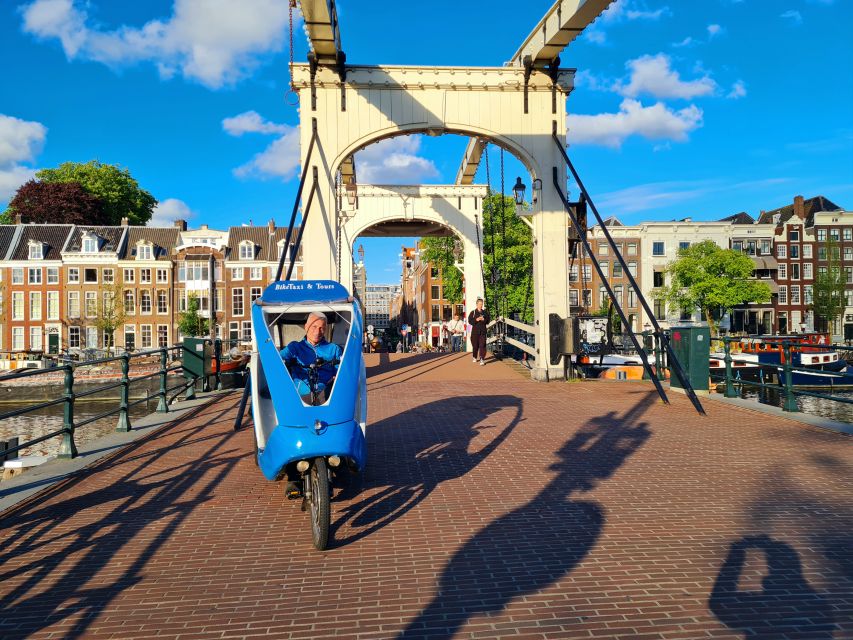
Then comes the Skinny Bridge, one of Amsterdam’s most recognizable crossings. Its design is especially attractive after dark, when hundreds of bulbs light its narrow structure. A daytime tour will still give you the river view, but you will not see the bridge in its nighttime lighting.
This is also a strong point for photographs. From here, you get a broad view across the canalized Amstel, the city’s main and widest canal. The tour explains how the river fits into Amsterdam’s layout, rather than presenting it as just another scenic waterway.
The route description calls this a panoramic view, and that is fair in practical terms: the river opens up, the bridge frames the scene, and the surrounding buildings show how tightly Amsterdam is built around its water.
The 17th-century canal ring
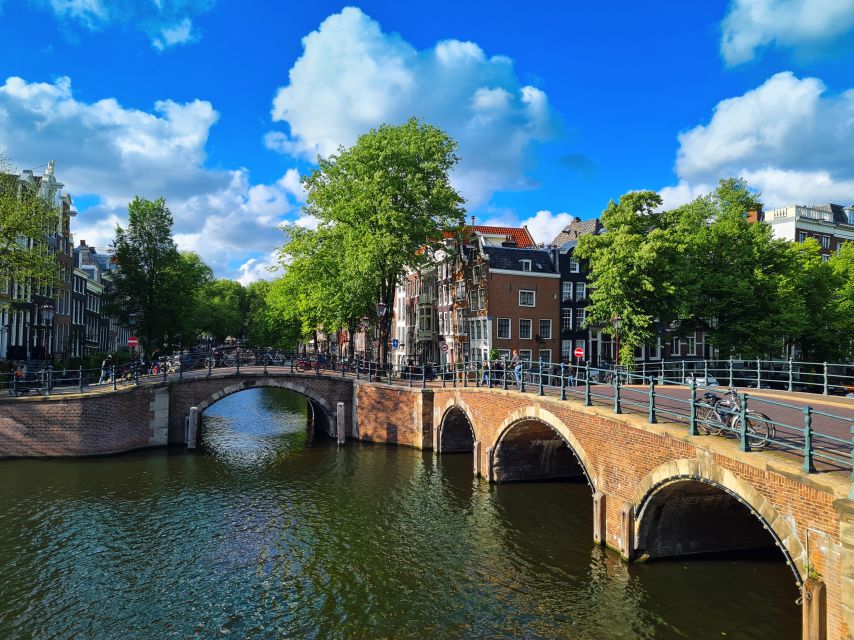
The canal district is the visual centrepiece of the experience. On a city map, the canals appear as half circles around the old centre. They were laid out in the 17th century, when successful merchants built houses along the waterways.
From the pedicab, you can study the façades without constantly stopping in the middle of pedestrian traffic. Bram points out that the houses are not identical, even though they share features that reveal when and how they were built.
That detail is useful because the canal ring can blur together if you simply admire one pretty street after another. Look for differences in width, roof shape, decoration, and proportions. The buildings reflect the period in which they were constructed and the wealth of the people who lived in them.
This is where the pedicab’s ability to use narrow streets becomes especially useful. A car would be too large or inconvenient on some of these routes, while walking the whole canal ring takes much longer. You get an overview without giving up the close view of the façades.
The trade-off is that you will not stop at every famous canal corner. Think of this part as an introduction that helps you decide which canals deserve a longer walk later.
Museumplein and the Rijksmuseum tunnel
The final major stop is Museumplein, a large 19th-century green square surrounded by important cultural institutions. The Rijksmuseum and Van Gogh Museum are the best-known names here.
The pedicab passes through the Rijksmuseum tunnel and stops in the middle of the square. That is a memorable way to approach the museum district, even if you are not planning to enter either museum during the tour.
Museumplein works well as the final stop because it shows a different Amsterdam. The old centre is dense and shaped by defense, trade, and canals. Here, the city opens into a broad public space built around national art collections.
You can arrange a preferred end point in advance, and the tour includes hotel drop-off. This makes the experience easier to fit into a sightseeing day. You might finish at your hotel, remain near Museumplein for a museum visit, or choose another agreed location.
What the two-hour schedule really gives you
Two hours is enough for a strong first look at Amsterdam, not enough for detailed visits inside each district. You will see a long list of major areas, but your time at each one is limited.
I would use this tour early in your stay. It gives you a mental map of the city and helps you choose where to return on foot. For example, you might later spend more time at the Portuguese Synagogue, walk the canal ring, or visit the Rijksmuseum after the pedicab ride.
The private format also allows you to ask questions as you go. Past rides have included detailed explanations of Amsterdam’s origins, neighborhood changes, canal development, and wartime occupation. Bram has also used visual aids, which can be handy when a building’s present appearance does not reveal its past.
If you want to stretch the experience, one booking was extended from two hours to three. Treat that as something to arrange rather than something guaranteed. The advertised duration is two hours.
Comfort, access, and practical limits
The pedicab is a strong option for seniors or anyone with limited walking ability. You remain seated for most of the tour and can cover central sights without crossing the city on foot. A blanket is available in cold weather, and it proved useful on cool, rainy days.
You should still bring warm clothing. Amsterdam weather can change quickly, and the vehicle is open to the air. The blanket is a helpful extra, not a substitute for a coat.
The ride is not suitable for anyone over 100 kilograms, and the combined passenger weight cannot exceed 200 kilograms. These limits are important for safety and comfort. If two passengers are traveling together, check your combined weight before paying.
The tour includes pickup and drop-off at your hotel. Wait outside in front of the hotel at the agreed time. Food and drinks are not included, so plan a café stop before or after the ride if that matters to you.
The price is $230 per group of up to two people. For two passengers, that works out to $115 each. That is more than a shared walking tour, but you are paying for a private vehicle, hotel pickup, a local guide, and a route that covers several districts in one sitting.
I see the best value here for two people who might otherwise need taxis, several separate tours, or a full day of walking. For a solo visitor, the per-person cost is much harder to justify. The private setting and limited passenger count are the main reasons to choose it.
Cancellation is free up to 24 hours before departure, and you can reserve now while paying later. Starting times depend on availability.
Who should book this Amsterdam pedicab tour?
I would recommend it to first-time visitors who want a broad view of Amsterdam before exploring on their own. It is also a practical choice for couples, older visitors, and people who find long walking tours tiring.
You will get the most from it if you enjoy local stories, urban history, and changing neighborhoods. Bram speaks English, Dutch, and German, and his explanations include personal insight into the city rather than only a list of dates.
I would think twice if you want extensive time inside museums, a food-focused outing, or a fast way to cross town. The tour is for seeing and understanding, not for checking off every attraction from the inside.
Should you book it?
Book this private Amsterdam pedicab tour if you want to cover the old centre, canal ring, Jewish Quarter, Amstel, and Museumplein in two comfortable hours. Bram’s maps, photographs, and detailed explanations add real value, while the private format makes it easy to ask questions and request a photo pause.
For two people, the cost is reasonable when you value hotel pickup and limited walking. Check the passenger-weight rules, dress warmly, and use the ride as an orientation tour. Afterward, return to the places that deserve more time.
FAQ
How long is the Amsterdam pedicab tour?
The tour lasts two hours. A longer three-hour ride has been arranged before, but the standard advertised duration is two hours.
How many people can join the private tour?
The price covers a private group of up to two passengers.
What languages does the guide speak?
The live guide can conduct the tour in English, Dutch, or German.
Is hotel pickup included?
Yes. Pickup and drop-off are included. You should wait outside in front of your hotel.
Where does the tour begin?
The tour starts at Dam Square, in the heart of Amsterdam’s old centre, with hotel pickup included.
What places will I see?
The route includes Dam Square, Zeedijk, nearby Chinatown, New Market Square, Montelbaanstoren, the Jewish Quarter, the Big Synagogue, the Portuguese Synagogue, the Holocaust Names Monument, the Hermitage, the Skinny Bridge, the 17th-century canal district, and Museumplein.
Is food included?
No. Food and drinks are not included in the tour price.
Is the pedicab suitable for everyone?
The maximum combined passenger weight is 200 kilograms, and no passenger can weigh more than 100 kilograms. The experience may suit people with limited walking ability, but it is not suitable for passengers over the stated weight limit.
More Amsterdam Highlights Tours
- Rotterdam: Harbor Sightseeing Cruise
★ 4.3 · 7,599 reviews - Rotterdam: 1-Hour Sightseeing Splash Tour
★ 4.5 · 3,299 reviews - Amsterdam Sightseeing Canal Cruise with Audio Guide
★ 3.5 · 828 reviews - Haarlem: Sightseeing Canal Cruise through the City Center
★ 4.3 · 762 reviews
More Sightseeing Tours in Amsterdam
- Amsterdam: Hidden Gems & Highlights Guided Bike Tour
★ 4.8 · 1,404 reviews - Amsterdam Highlights Bike or E-Bike Tour
★ 5.0 · 1,171 reviews - Amsterdam Highlights Walking Tour: Small Group Experience
★ 5.0 · 1,132 reviews - Amsterdam: Relaxed City Highlights Guided Bike Tour
★ 4.7 · 1,069 reviews
Just added around Amsterdam
- Amsterdam: Food and Canal Tour★ 4.6 · 22 reviews
- Segway City Tours Amsterdam★ 4.3 · 23 reviews
- Amsterdam Canal Cruise in Classic Salon Boat With Drinks and Cheese★ 4.0 · 22 reviews
- Discover Deventer with an Outside Escape city game tour!★ 4.5 · 23 reviews
- Historical Walking Tour, private with local Dutch guide★ 5.0 · 23 reviews
- Utrecht Food Tour on a Bicycle with local guide★ 5.0 · 23 reviews
- Amsterdam: Captain For a Day 2-Hour Boat Rental★ 4.9 · 23 reviews
- Amsterdam Small-Group Breakfast Morning Cruise★ 5.0 · 23 reviews
Historical Tours, compared.
Amsterdam Food and Cultural Tour with Tastings
Read our review →
Kinderdijk UNESCO World Heritage Entry Ticket
Read our review →
Hop-on Hop-off Old-Fashioned Heritage Tram Tour
Read our review →


Amsterdam High-End Dutch Food & History Tour – Up to 8 guests
Read our review →
Cruise through the Historic City Center with Guide
Read our review →
Browse the lists this tour appears in