
Reviewed · EINDHOVEN TOURS
Eindhoven: journey to the future
Eindhoven is not simply a Dutch city with a famous electronics company. It is a place where Philips factories became design districts, old religious buildings became hotels, and students imagine new uses for plants, solar power, and 3D printing. This three-hour private walk connects those pieces in a way a quick visit often misses.
I like the tour’s focus on human-centered city planning and its calm pace. I also like the mix of big ideas and physical places, from the Lichttoren and De Blob to the former industrial quarter. The main caution is the price: at $285.94 per person, this is a costly walking tour unless you value private guiding and detailed conversation.
In This Review
- Key points to know before booking
- Why Eindhoven makes a good city walk
- Starting at Central Station with the city’s future in mind
- The Lichttoren and Eindhoven’s many kinds of light
- De Blob, futuristic shapes, and ideas that sound far-fetched
- Philips, Einstein, and affordable museum access
- Hotel Mariënhage and a 13th-century past
- Design Academy Eindhoven and bold solutions
- Modern art, design, and one local rivalry
- From industrial duck to creative swan
- Pace, guide style, and private value
- Who should book this Eindhoven walk?
- Should you book Journey to the Future?
- FAQ
- Where does the tour begin?
- Where does the tour finish?
- How long does the experience last?
- Is this a private tour?
- What language is offered?
- Who guides the tour?
- Are admission tickets included?
- Are food and drinks included?
- Can I cancel for a full refund?
Key points to know before booking
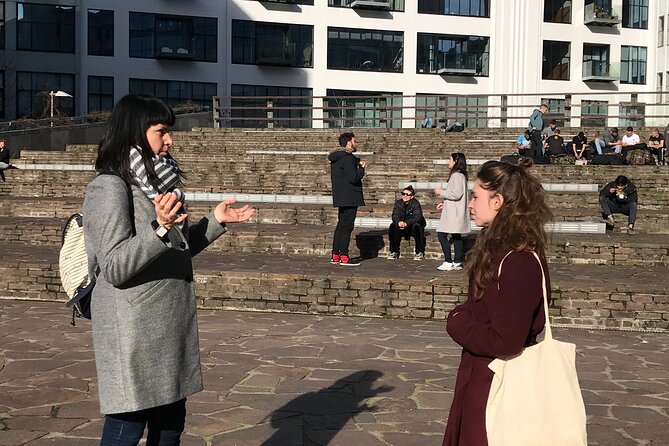
- A private walk with Anna: Your group receives a guide’s full attention, with Anna named as the main guide in the tour information. One account spells her name Anya.
- Philips is the backbone: The route explains why Eindhoven is called the city of light and how the company shaped local work, architecture, culture, and identity.
- Future-minded design: Expect discussion of solar energy cars, 3D printing, sustainability, public spaces, and experimental work from Design Academy Eindhoven.
- Several stops are free to enter: The tour is mainly an outdoor city walk, so the cost pays for guiding rather than museum admissions or meals.
- A thoughtful three-hour pace: Most stops last 15 minutes, while the Design Academy and industrial heritage sections receive about 30 minutes each.
- It returns to the start: Meet at Monkey Coffee NS Eindhoven at Stationsplein 22-13, near Central Station, and finish back there.
Why Eindhoven makes a good city walk
Eindhoven can seem plain at first glance. It lacks the postcard canals of Amsterdam and the old stone drama of some Dutch cities. Its appeal is more recent and more practical: this is a city shaped by industry, invention, reconstruction, and design.
That makes it a good place for a walking tour with a clear theme. You are not just ticking off monuments. You are looking at how a company, a technical school, and a changing economy altered the way a city works.
The opening question about human-centered urban planning gives the walk a useful frame. Instead of treating streets and public squares as decoration, the tour asks how a city can be easier and more pleasant to live in. That is a strong beginning because Eindhoven’s modern identity is tied to practical design, not just appearance.
The tour is also private. Only your group takes part, which gives you room to ask questions and adjust the conversation. If you are curious about architecture, technology, museums, or local life, that flexibility matters more than it would on a large group outing.
A few more Eindhoven half-days to weigh up
- Eindhoven: Motion Experience Light Art Playground Ticket
★ 4.0 · 168 reviews - Eindhoven: PSV Stadium Museum Entry Ticket
★ 4.1 · 101 reviews - Eindhoven: Philips Museum Entry Ticket
★ 4.3 · 95 reviews
Starting at Central Station with the city’s future in mind
Meet at Monkey Coffee NS Eindhoven, at Stationsplein 22-13, in front of Eindhoven Central Train Station. The station area is a sensible starting point because it places you immediately in the middle of the city’s transport network and modern public life.
The first 15 minutes focus on why Eindhoven attracts residents and what urban planners mean by human-centered design. I would pay close attention here, since this opening can help you read the rest of the route. You will be encouraged to look at buildings, open areas, and movement through the city from the point of view of people who use them every day.
This is not a formal architecture lecture. The appeal is the connection between design and ordinary life. The tour asks why a city feels usable, how public areas function, and how new construction can serve more than a corporate purpose.
Because this is a walking experience, wear comfortable shoes. The published timing suggests a steady pace rather than a rushed march, but three hours on city streets still requires sensible footwear.
The Lichttoren and Eindhoven’s many kinds of light
The second stop is the Lichttoren, another 15-minute pause. Its name means light tower, and it points directly to Eindhoven’s Philips past.
The tour explores several possible reasons for the city’s nickname, City of Light. Philips manufactured light bulbs here, the tower became a visual marker in the center, and the city’s illumination has even been linked to what can be seen from space. The exact answer matters less than the way these ideas show Eindhoven’s self-image.
The Lichttoren is a useful place to discuss industrial identity because it is not just an old building left behind. It has become part of the city’s public story. You can see how a former production center remains meaningful after its original use changes.
I like this part because it takes a familiar company name and turns it into a question about place. Philips is not treated as a logo floating above the city. Its work affected the skyline, jobs, inventions, and the way Eindhoven presented itself to the world.
De Blob, futuristic shapes, and ideas that sound far-fetched
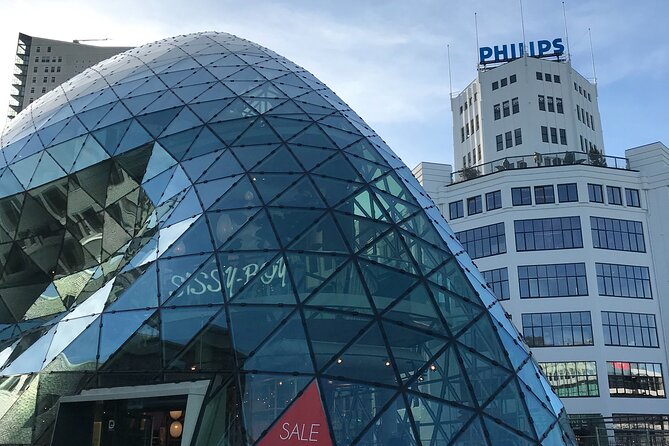
The 15-minute stop at De Blob shifts the focus from industrial light to contemporary technology and architecture. Its unusual form is hard to miss, and the route uses it to discuss Eindhoven’s interest in the future.
Topics include 3D printing and solar energy cars, along with broader questions about what technology may bring to human life. You are likely to get more from this stop if you enjoy ideas as much as buildings. The point is not simply to photograph a strange structure. It is to consider how a city presents innovation in public space.
De Blob also helps show the contrast between older Philips buildings and newer commercial development. Eindhoven’s center is not frozen in one period. It contains industrial remnants, glass and steel towers, shopping areas, and experimental design.
One account describes the nearby Philips quarter as a renewed industrial center with the Lichttoren, De Admirant, and the former Witte Dame headquarters. Those names help you understand the area’s range. The Witte Dame has been reused for conferences, exhibitions, and a coffee bar, while De Blob serves as a modern shopping center. The route’s value is in explaining how such buildings relate to one another.
Same city, a completely different afternoon:
- Eindhoven: Next Nature Museum Entry Ticket
★ 3.9 · 83 reviews - Eindhoven: Bottle Distillery Tour and Tasting Experience
★ 4.9 · 74 reviews - Eindhoven: City Center Walking Tour
★ 4.7 · 43 reviews - Discover the best spots in Eindhoven with Outside Escape
★ 4.5 · 40 reviews
Philips, Einstein, and affordable museum access
At a point between the main listed stops, the guide turns to two useful subjects: Albert Einstein’s visit to Eindhoven and the inventions associated with Philips.
The Einstein connection adds a human story to the city’s technical reputation. The tour also asks you to think about the company’s greatest inventions, so this portion should appeal to anyone who wants more than a list of buildings.
Another topic is the Dutch museum system and how people living in the Netherlands can visit major museums in Amsterdam as well as small local heritage museums without paying full admission each time. The tour does not include museum tickets, snacks, or drinks, but this explanation can help you plan later sightseeing.
That is a practical touch. Eindhoven is often used as a base for visiting other Dutch cities by train, and one account specifically praised the ease of discovering the Netherlands from here. If you are staying in Eindhoven for several days, information about museum access may be as useful as the architectural commentary.
Hotel Mariënhage and a 13th-century past
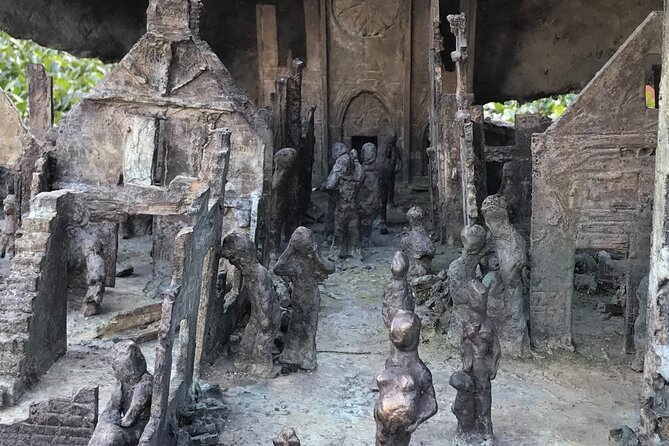
Hotel Mariënhage receives another 15-minute stop. The building now offers modern hotel accommodation and fine dining, but its origins reach back to a 13th-century abbey.
This is one of the tour’s best examples of adaptive reuse. You can see how an older religious site can take on a new role without losing its connection to the city’s past. The contrast is neat: a place once tied to monastic life now serves visitors seeking rooms, food, and contemporary comfort.
The stop also prevents the tour from becoming too heavily focused on Philips. Eindhoven’s story includes more than factories and laboratories. Religious foundations, hospitality, food, design, and public life all help explain how the city has changed.
You should not expect a long interior visit or a meal here. The tour includes only a guided stop, and snacks, coffee, and tea are not included. If fine dining interests you, treat this as a useful introduction to the building rather than a reservation.
Design Academy Eindhoven and bold solutions
The Design Academy receives the longest focused stop, about 30 minutes. This is where the tour’s future-facing theme becomes most concrete.
The school is known for encouraging students to question standard frameworks. Its favored subjects include sustainability, well-being, quality of life, public spaces, and environmentally responsible living. These themes are not abstract here. Graduation projects have included bags made from cow stomachs and research into using plants to create organs compatible with the human body.
Some of these ideas may sound strange. That is part of the point. Design education here is not limited to making attractive chairs, lamps, or buildings. It asks what materials we use, how we care for bodies, and how products affect the planet.
I like that the stop presents design as a tool for solving problems rather than a style label. You may agree with the students’ proposals, or you may find some too experimental. Either way, the discussion gives you a sharper way to look at Eindhoven’s public buildings and industrial conversions.
A possible limitation is that the tour does not promise entry to a working exhibition or graduation show. The information supports a guided discussion of the academy and its ideas, not a guaranteed interior program. If seeing student work is your main goal, check the schedule separately before booking.
Modern art, design, and one local rivalry
The route also explains how Eindhoven became home to one of the Netherlands’ most influential modern art and design museums. The story is tied to the passion of a local captain of industry and his rivalry with other industrial leaders.
That rivalry gives the cultural story some useful tension. Museums do not appear by magic. They often grow from private collections, personal ambition, money, competition, and a desire to shape a city’s reputation.
The tour does not reduce Eindhoven to a technology center. It shows how industry helped support art and design, too. This link is important because the city’s creative identity did not arrive after the factories disappeared. It developed alongside them.
For you, the practical benefit is a better sense of what to see after the walk. If modern art and design appeal to you, the guide’s explanation can help you decide how to spend a separate museum visit.
From industrial duck to creative swan
The final major section gives about 30 minutes to Eindhoven’s industrial heritage. The route asks you to respect the city’s working past while considering the transformation of former industrial buildings into modern icons.
The phrase industrial duck into creative swan captures the basic idea without pretending the change was simple. Old factories and company buildings can become galleries, offices, restaurants, schools, or public spaces, but that process raises questions about memory, jobs, access, and the cost of renewal.
The tour invites you to walk an extra distance to see additional buildings that have become icons. Since this is a private activity, you can discuss how far you want to go with the guide. Still, the supplied timing suggests that walking is central to the experience, and the extra section may add physical effort near the end.
This final part should be especially useful if you have already seen the main center and want context. Instead of viewing renovated buildings as isolated photo stops, you learn how they fit into Eindhoven’s wider change.
Pace, guide style, and private value
The tour lasts about three hours. Most stops receive 15 minutes, while the Design Academy and industrial heritage section receive 30 minutes. That rhythm allows for short explanations, movement between areas, and questions without making every stop feel like a formal presentation.
The guide’s style appears calm and conversational. Anna is described in the tour information as the guide, while one account refers to Anya. Either way, confirm the guide’s name when booking if that detail matters to you.
The personal approach is a major part of the value. You are not paying for admission to a collection of attractions. The listed stops are free, and the guide is the included service. The price of $285.94 per person is therefore high for a three-hour walk, especially for a solo booking or a very small party.
It becomes easier to justify for a group that can share the private experience, particularly because group discounts are available. Ask for the current group rate before booking. You are paying for tailored attention, a connected theme, and the chance to ask about Philips, museums, design, and local life in one conversation.
The six published ratings are all five-star ratings, with repeated praise for the guide’s clear storytelling, calm pace, professional manner, and wide range of subjects. I would treat that as a good sign about the guiding, but not as proof that every visitor will find the price right.
Who should book this Eindhoven walk?
I would choose this tour if you enjoy cities that explain themselves through work, design, and change. It suits curious adults, architecture fans, technology enthusiasts, and people who prefer a thoughtful walk to a checklist of monuments.
It can also work well for a private family or friend group with mixed interests. The guide can connect old abbey buildings, industrial history, modern art, and future technology, so different people have several ways into the story.
I would think twice if you want museum interiors, a meal, or a low-cost introduction to Eindhoven. Coffee and tea are not included, and the tour does not promise admission to the academy, an art museum, or other buildings. You are buying interpretation and company on the streets, not a package of tickets.
The meeting point is easy to reach near public transportation, and most people can participate. Confirmation arrives at booking, and free cancellation is available until 24 hours before the start time. Changes or cancellations inside that window are not accepted for a refund.
Should you book Journey to the Future?
Book it if you want Eindhoven explained as a living project rather than a former Philips town. The strongest parts are the connection between the Lichttoren, De Blob, Design Academy Eindhoven, and the renewed industrial quarter, along with the guide’s calm, informed storytelling.
Skip it if the $285.94 price feels too steep for a three-hour walk or if you mainly want to enter museums. For a group that values a private guide and wants to understand why Eindhoven looks and feels different from older Dutch cities, this can be a rewarding choice. Ask about the group discount, bring comfortable shoes, and arrive ready to discuss ideas as much as buildings.
FAQ
Where does the tour begin?
It begins at Monkey Coffee NS Eindhoven, Stationsplein 22-13, 5611 AC Eindhoven, Netherlands, at the square in front of Eindhoven Central Train Station.
Where does the tour finish?
The activity ends back at the meeting point near Eindhoven Central Train Station.
How long does the experience last?
The walking tour lasts approximately three hours.
Is this a private tour?
Yes. Only your group participates in the activity.
What language is offered?
The tour is offered in English.
Who guides the tour?
The guide is identified as Anna in the tour information. One account spells the name Anya.
Are admission tickets included?
The listed stops have free admission, and a guide is included. The activity does not list paid museum admission as an included feature.
Are food and drinks included?
No. Snacks, coffee, and tea are not included.
Can I cancel for a full refund?
Yes, if you cancel at least 24 hours before the experience start time. Cancellations or changes made less than 24 hours before the start time are not accepted for a refund.
Just added around Eindhoven
- Roermond Self Guided Sherlock Holmes Murder Mystery Game★ 4.5 · 3 reviews
- Eindhoven: Private Guide for a Bike Tour★ 5.0 · 4 reviews
- Comedy Walks© Eindhoven (the comedy walking tour)★ 3.5 · 10 reviews
- Eindhoven: E-Fatbike Tour In The Footsteps of Vincent van Gogh★ 4.0 · 11 reviews
- e-Scavenger hunt Roermond: Explore the city at your own pace★ 4.5 · 16 reviews
- Eindhoven: Wings of Liberation, The WWII Airborne experience★ 4.7 · 20 reviews
- Eindhoven: Strijp-S Industrial Park Guided Walking Tour★ 4.3 · 21 reviews
- Eindhoven: Guided bicycle tour of the Highlights of Eindhoven★ 5.0 · 27 reviews
Eindhoven Tours, compared.

e-Scavenger hunt Den Bosch: Explore the city at your own pace
Read our review →Browse the lists this tour appears in