
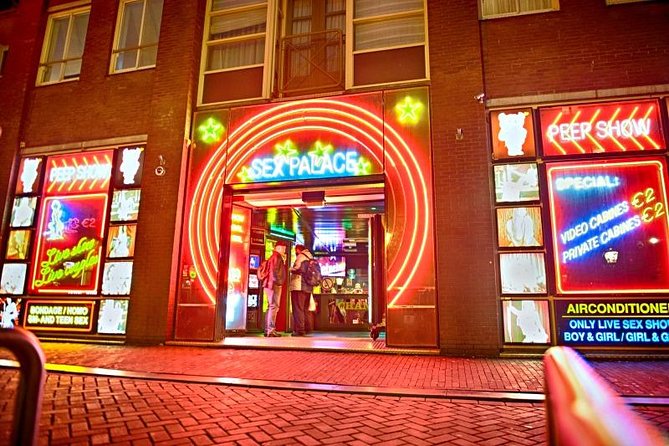
Reviewed · RED LIGHT DISTRICT TOURS
MUST DO: Amsterdam’s Red Light District tour with a local
Amsterdam’s Red Light District is far more than neon windows. It is the oldest part of the city, packed into narrow lanes where medieval defenses, trading history, canals, pubs, sex work, and modern Amsterdam all meet. This two-hour evening walk uses that setting as an open-air classroom, with a local guide explaining what you are seeing and how the district functions today.
I like the route for two reasons: it adds solid city history to a subject often treated as a joke, and walking keeps you close to small details you would miss from a vehicle. Guides such as Ben, Robin, Sander, and Max have been praised for clear stories, humor, and useful local tips. The main drawback is that the experience depends heavily on the individual guide and the conditions underfoot. One poor experience involved a hard-to-hear guide, while icy streets and a missed meeting time caused another serious complaint.
In This Review
- Key points to know before booking
- What this walk reveals about Amsterdam’s oldest quarter
- Meeting at Geldersekade 2 after dark
- Wooden foundations beneath the city
- Dam Square and the city built on trees
- Int Aepjen, one of two remaining wooden buildings
- The Waag and Amsterdam’s defensive edge
- Amsterdam’s smallest house and the VOC connection
- A condom shop and the modern district
- How much of the tour is really about the Red Light District?
- The guides make or break the experience
- Is $31.32 a fair price?
- Who should book this Amsterdam walking tour?
- Should you book this Red Light District tour?
- FAQ
- How long is the Amsterdam Red Light District tour?
- Where does the tour start?
- Where does the tour end?
- Is the tour offered in English?
- What is included in the price?
- How many people can join the tour?
- Can I cancel for a full refund?
Key points to know before booking
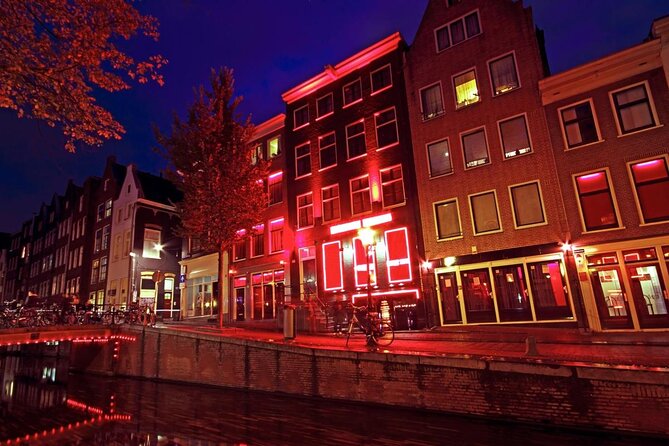
- The Red Light District is only part of the story: Much of the walk covers Amsterdam’s oldest streets, buildings, foundations, and trading past.
- Expect a guide-led history walk: Ben, Robin, Sander, and Max have each received strong praise for their storytelling and local advice.
- The route includes unusual stops: You may see Int Aepjen, the Waag, Amsterdam’s smallest house, and the city’s first condom shop.
- After-dark timing changes the mood: Narrow lanes, illuminated windows, and busy streets create a very different atmosphere from a daytime city walk.
- The pace is on foot for about two hours: Wear shoes with a good grip and arrive early at Geldersekade 2.
- The group can reach 20 people: That is small enough for a personal feel, but not the same as a one-to-one private tour.
What this walk reveals about Amsterdam’s oldest quarter
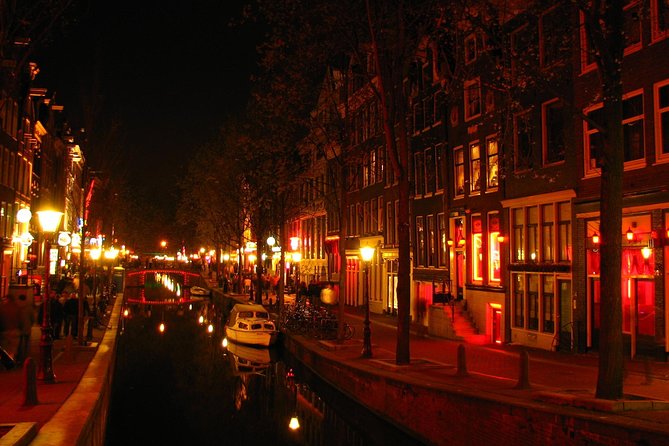
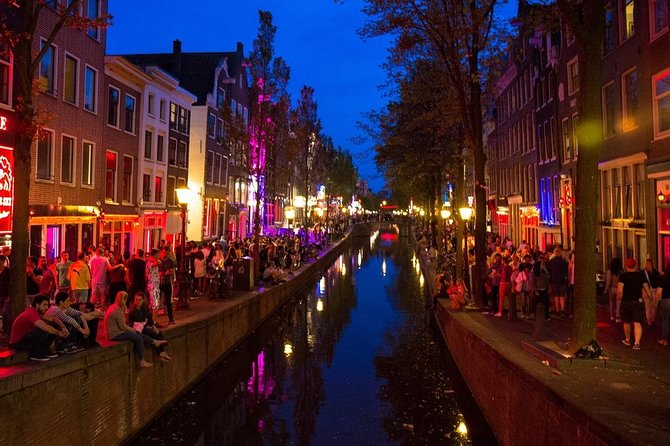
The Red Light District, known locally as De Wallen, sits in Amsterdam’s Old Town. That location matters. You are not being led to a separate entertainment strip built for visitors. You are walking through one of the city’s oldest settled areas, where old buildings and working streets share space with sex businesses, cafés, shops, and historic landmarks.
That mix gives the tour its real value. If you only walk through the district alone, you may notice the red-lit windows and crowds but miss the reason the streets look as they do. A guide can connect the area’s current identity with its past as a port district, a defensive edge, and a center of trade.
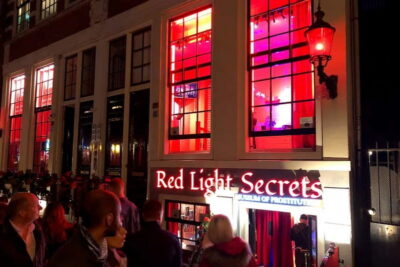
The route also helps put the sex industry in context. The goal is not simply to point out windows or make crude jokes. You should expect discussion of the district’s history and its present situation, along with cultural information about Amsterdam’s approach to sex work and cannabis. One stop includes a cannabis shop, according to the experience details, though food and drinks are not included.
The tone will not suit everyone. The subject is adult, and the narrow streets can feel crowded and exposed. If you want a quiet architectural walk, this is not the right setting. If you want to understand a complicated part of Amsterdam without treating it as a sideshow, the subject matter is handled in a more useful way.
More Red Light District walks:
- Amsterdam: Red Light Secrets Museum Entry Ticket
★ 4.2 · 5,722 reviews - Amsterdam: Red Light District Tour in German/English/Italian
★ 4.9 · 5,623 reviews - Amsterdam Red Light District & Coffee Shop Tour
★ 4.6 · 4,134 reviews
Meeting at Geldersekade 2 after dark
The walk begins at Geldersekade 2, 1012 BH Amsterdam, and returns to the same meeting point. The central location makes it practical to fit into an evening in the Old Town, but you should allow time to find the exact spot before the start.
Arrive early. This is especially important in bad weather or during busy evening periods, when the streets can be noisy and hard to navigate. One serious complaint came from a pair who arrived two minutes after the stated start time in icy conditions and found that the group had already left. The operator stated that the guide waited until 18:10 and attempted to call and text, and a full refund was issued, but the episode shows why punctuality matters here.
You will be walking on narrow streets for roughly two hours. Amsterdam’s old center has uneven surfaces, bicycles, crowds, and changing weather. Wear warm layers and shoes with a firm grip. The activity is not recommended for people with limited mobility, and the operator specifically notes that most people can participate but that service animals are allowed.
The tour is offered in English and uses a mobile ticket. The maximum group size is 20. That is a reasonable limit for a street tour, though your ability to hear the guide may depend on where you walk in the group. One low-rated experience reported that the guide moved ahead while talking and was difficult to hear. Staying near the front is sensible.
Wooden foundations beneath the city
One of the first useful facts on the route concerns Amsterdam’s ground. The city sits on thick layers of fen and clay, with firmer sand roughly 11 meters below. Many buildings rest on long wooden piles driven down through the soft soil until they reach that sandy layer.
This explains a feature you may otherwise overlook: Amsterdam’s old buildings can appear tall, narrow, and slightly tilted. Their foundations are part of the city’s story, not just an engineering footnote. The guide uses this point to show how the city was built in a wet setting where ordinary foundations would not have worked.
The detail also gives the walk a wider frame. The district is not only about what happens in the windows. Its streets, buildings, and survival over centuries reflect the practical problems faced by a city built around water and trade.
Dam Square and the city built on trees
The itinerary includes a stop connected with the Dam, the historic heart of Amsterdam. The city is sometimes described as being built on trees because of the wooden foundation piles supporting many structures.
This is the sort of stop that rewards a guide. The physical feature is largely beneath your feet, so you will not see the piles from the street. What you gain is a clearer sense of why Amsterdam’s old architecture looks the way it does and why construction here has always required unusual solutions.
Because the walk covers a compact old district, this history does not feel detached from the rest of the route. You move from a modern adult-oriented street to centuries-old buildings within minutes. That contrast is one of the strongest reasons to choose a guided walk instead of simply wandering alone.
A few more Amsterdam half-days to weigh up
- Amsterdam: Van Gogh Museum Ticket
★ 4.7 · 52,054 reviews - Amsterdam Classic Saloon Boat Cruise with Drinks and Cheese
★ 5.0 · 31,825 reviews - Amsterdam Luxury Canal Cruise + Unlimited Drinks & Bites option
★ 5.0 · 30,518 reviews - Amsterdam: Heineken Experience Ticket
★ 4.6 · 30,055 reviews
Int Aepjen, one of two remaining wooden buildings
Pub Int Aepjen, also called The Ape, dates to around 1540. It is one of only two remaining wooden buildings in Amsterdam, making it an important stop even if you have little interest in nightlife.
The building’s survival is tied to a major fire in 1452. After that disaster, the government required buildings to have brick façades, which helps explain why an old wooden structure is so unusual today. The stop turns a small pub into a lesson about fire, building rules, and the changing appearance of Amsterdam.
You should not expect a long interior visit or a meal here. Food and drinks are not included, and the tour is primarily about seeing the place and hearing its story. Still, it is a memorable detail, particularly for anyone who likes old buildings with a practical past.
The Waag and Amsterdam’s defensive edge
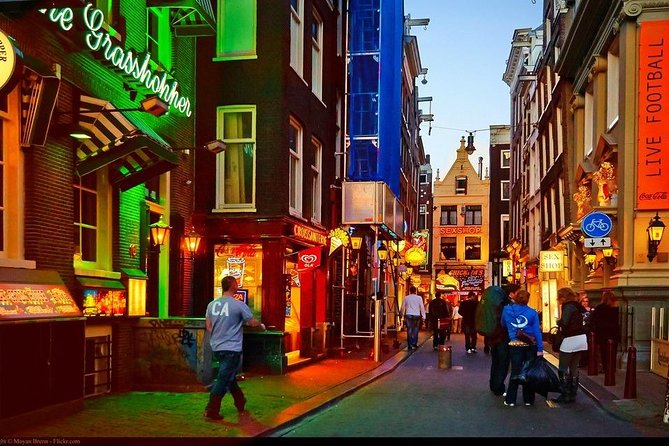
The Waag is another major historical marker. Built around the 1400s, it once served as one of Amsterdam’s city gates and formed part of the defensive wall. It is also described as the city’s second-oldest building.
Later, the Waag housed guilds, the organizations that represented craftspeople and trades. Its location and changing use show how Amsterdam grew from a defended settlement into a commercial city with organized professions.
This is a strong example of what the guide adds. On your own, you might photograph the building and move on. With an explanation of the gate, wall, and guild system, you can read the structure as a record of the city’s development.
The Waag also helps balance the more sensational parts of the district. The area contains adult businesses, but it also contains civic buildings that reach back to medieval Amsterdam. The route does not ask you to choose between those identities. It shows how they occupy the same old streets.
Amsterdam’s smallest house and the VOC connection
The smallest house on the route dates to around the 1700s. It was first used as a storage place by the Dutch East India Company, known as the VOC, and was later used as a home for many years.
Small buildings like this make Amsterdam’s trading past feel concrete. The VOC is often discussed in broad economic terms, but a tiny storage building brings that world down to street level. It shows how limited space in the old city had to serve many purposes over time.
The stop is also a reminder that Amsterdam’s compact architecture was shaped by trade, land pressure, and narrow plots. You may find the building easy to miss without a guide. Its small size is the point, but it can disappear into the surrounding streets if you do not know where to look.
A condom shop and the modern district
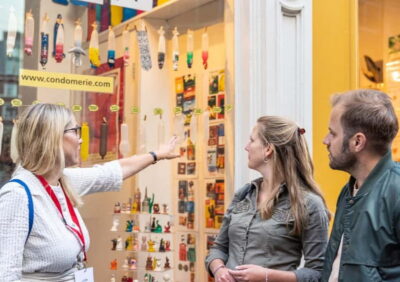
The walk includes what is described as the world’s first shop devoted specifically to condoms. It has been in place since 1987 and sells a range of unusual products, including customized sizes.
This stop reflects the district’s modern commercial identity and its willingness to treat sexual health and sexual products openly. It is also a lighter moment after the older stories about city walls, fires, foundations, and trading companies.
The stop may not appeal to every member of your group, particularly younger visitors. One review described an 18:00 version as more family-friendly and suitable for a 17-year-old, while suggesting that a later tour is better kept for adults. Since the tone can vary by departure and guide, check the option you are booking if you are traveling with teenagers.
How much of the tour is really about the Red Light District?
The answer depends on your expectations. The route is titled around the Red Light District, but one guide reportedly estimated that only about 15 percent of the talk was directly about the district’s sex industry. That is not necessarily a weakness.
Amsterdam’s Red Light District is compact. There are only so many useful facts to share about the windows, businesses, rules, and current situation before the subject becomes repetitive. The best version of this tour uses the district as a starting point and then explains the older city around it.
You will hear about the area’s sex industry and current character, but you will also spend time on architecture, trade, fire regulations, foundations, the city gate, and local customs. If you booked this hoping for two hours focused almost entirely on sex work, you may find the history-heavy balance surprising. If you want a broader introduction to the Old Town, the balance improves the value.
The guides make or break the experience
The strongest part of this walk is the guide. Ben has been praised for bringing Amsterdam’s history to life and for making the route both lively and informative. Robin has been described as personable, entertaining, and generous with local recommendations. Sander received strong marks for explaining Amsterdam’s past, and Max was praised for humor and for keeping the tour from becoming entirely about the Red Light District.
That range matters because this is not a museum visit with fixed displays. The quality comes from how clearly the guide speaks, how well the group stays together, and how thoughtfully the adult subject is handled.
Most of the feedback is very positive, especially on history, humor, and useful local advice. But you should keep the limitations in mind. One experience was rated poorly because the guide was hard to hear and did not appear to keep the small group together. Another complaint described rude and inappropriate comments from a guide, with no response received from the provider at the time of the complaint. That is a serious concern, even though it is not the dominant pattern in the available feedback.
I would book this for the chance to hear a good local guide, not for a guaranteed script or a museum-quality presentation. If your guide is Ben, Robin, Sander, or Max, the recorded feedback suggests you can expect a lively approach. Guide assignments can change, so treat those names as examples rather than a promise.
Is $31.32 a fair price?
At $31.32 per person, the cost is reasonable for a two-hour guided walk in central Amsterdam, especially if you are new to the city and want context quickly. There are no admission charges built into the route, but the value is not in paid attractions. It comes from the guide’s explanations and the order in which the sights are connected.
You are paying for orientation, local interpretation, and a structured route through streets that can feel confusing at night. That can save you from wandering past the Waag, Int Aepjen, or the smallest house without understanding why they matter.
The price is less appealing if you already know Amsterdam’s Old Town well or only want to see the illuminated windows. You can walk through the public streets without a ticket. The fee makes sense when you want background, a local perspective, and a more thoughtful explanation of the district’s present-day role.
Food and drinks are not included. Since the activity ends where it began, you can easily make your own plans afterward, but those expenses are separate.
Who should book this Amsterdam walking tour?
I would recommend it to first-time visitors who want to understand the Red Light District without reducing it to a novelty. It also suits anyone interested in old buildings, Amsterdam’s trading past, urban engineering, and the way historic neighborhoods adapt to modern life.
It is a good fit for adults who are comfortable discussing sex work and cannabis in a public setting. An earlier, more family-friendly option may work for older teenagers, but later departures are better treated as adult-oriented.
You should think twice if you have limited mobility, dislike walking on uneven or crowded streets, or need a guide who can provide a quiet, highly polished presentation. The route is outdoors, the group may reach 20 people, and one poor experience found the guide difficult to hear.
Book at least a little ahead if your dates are fixed. The experience is booked an average of 47 days in advance, which suggests that popular evening times can fill early. You receive confirmation when booking, and free cancellation is available until 24 hours before the start time. Changes or cancellations inside that window are not accepted for a refund.
Should you book this Red Light District tour?
Book it if you want history with the street atmosphere, not just a quick look at the red-lit windows. The best parts are the unusual connections: wooden piles beneath the city, a surviving wooden pub, a medieval gate, a tiny VOC storehouse, and a modern condom shop, all within one compact walk.
Skip it if your main goal is a private, deeply focused discussion of the sex industry or if you cannot manage a two-hour evening walk. Also arrive early and stay close to the guide, since timing, audibility, and group control can affect the experience.
For most first visits, I think the balance is worthwhile. You come away with a clearer understanding of why this famous district exists where it does, and you see Amsterdam as a living old city rather than a collection of neon signs.
FAQ
How long is the Amsterdam Red Light District tour?
The walking tour lasts approximately two hours.
Where does the tour start?
It starts at Geldersekade 2, 1012 BH Amsterdam, Netherlands.
Where does the tour end?
The activity ends back at the meeting point on Geldersekade.
Is the tour offered in English?
Yes. The tour is offered in English.
What is included in the price?
The price includes the two-hour walking tour. Food and drinks are not included.
How many people can join the tour?
The maximum group size is 20 people.
Can I cancel for a full refund?
Yes. You can cancel at least 24 hours before the experience start time for a full refund. Cancellations or changes made less than 24 hours before the start time are not accepted for a refund.
Just added around Amsterdam
- Amsterdam: Food and Canal Tour★ 4.6 · 22 reviews
- Segway City Tours Amsterdam★ 4.3 · 23 reviews
- Amsterdam Canal Cruise in Classic Salon Boat With Drinks and Cheese★ 4.0 · 22 reviews
- Discover Deventer with an Outside Escape city game tour!★ 4.5 · 23 reviews
- Historical Walking Tour, private with local Dutch guide★ 5.0 · 23 reviews
- Utrecht Food Tour on a Bicycle with local guide★ 5.0 · 23 reviews
- Amsterdam: Captain For a Day 2-Hour Boat Rental★ 4.9 · 23 reviews
- Amsterdam Small-Group Breakfast Morning Cruise★ 5.0 · 23 reviews
Red Light District Tours, compared.
Red Light District Tour in German/English/Italian
Read our review →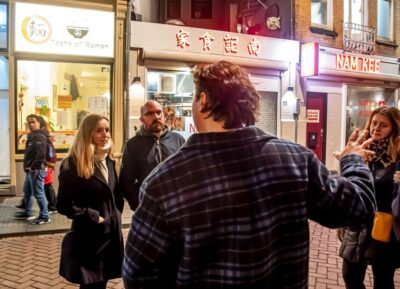
Amsterdam Red Light District & Coffee Shop Tour
Read our review →
Red Light District Pub Crawl with Unlimited Shots
Read our review →

Private Amsterdam Red Light District and Coffee Shop Tour
Read our review →Browse the lists this tour appears in